

A two-year-old was bitten at a sled dog excursion in Alaska in May 2026. The child had been brought within contact distance of an adult working dog immediately after a run. The dog was not aggressive by any standard assessment. It was overstimulated, tired, and had nowhere to go.
Working dogs are not aggressive by default. They are, however, large, strong, fast to react, and completely unpredictable to people who do not read them. A Malamute coming off a run at minus ten is not the same animal as a Malamute in a staged photo with a child in a brochure. Those are two different dogs in two different physiological states.
I have run sled dog experiences here in Petersburg for years. I have also turned away paying customers mid-briefing because what they described wanting was not something I was willing to provide. A toddler touching a working dog’s face immediately post-run is not a family-friendly activity. It is a liability waiver waiting to be tested.
That waiver is the core of this problem. The tourism operator hands a family a legal document and a verbal assurance, and the document protects the operator while the assurance shapes the family’s expectations. Those two things are in direct conflict, and everyone in the industry knows it. Nobody wants to say it out loud because it closes bookings.
Here is what actually happens to a sled dog after a run. Core temperature is elevated, adrenaline is still present, and the dog is processing the transition from high-intensity work to sudden stillness. Some dogs handle that transition well. Many do not, and the ones who struggle do not signal distress the way a pet dog would. They compress, they stiffen, they redirect, and they do it fast.
A handler who knows dogs reads that sequence in two seconds and moves the public back. A seasonal guide working their third week in Alaska does not see it at all. They see a dog that is standing still, which they interpret as a dog that is calm. Those are not the same thing.
I apply TTouch to every dog in my team before and after public contact sessions. That is not a wellness practice I added because it sounds good on a website. It is a functional assessment tool that tells me which dogs are ready to be approached and which ones need to be left alone. Most commercial sled dog operators have no equivalent protocol. They have a dog on a line and a family with a camera.

The cruise excursion model compounds every one of these problems. Passengers are processed in groups, time is short, guides are managing logistics rather than reading dogs, and the operators are incentivised to keep experiences positive-feeling rather than safe. A bite incident is bad for reviews. A turned-away family who wanted a photo is also bad for reviews. The industry has been choosing the second risk for years and occasionally collecting the first.
I want to be clear about what standardised child safety protocols would actually require. They would require operators to define a minimum age for close-contact access, a mandatory rest period between run completion and public contact, and a handler-to-dog ratio that allows genuine supervision. None of that is technically difficult. All of it reduces throughput and raises operating costs.
The industry does not lack the knowledge to build these standards. It lacks the financial incentive. Self-regulation in commercial dog tourism has produced exactly the level of safety that self-regulation without consequence always produces.
The Reddit threads and cruise forums filling up with this story are full of people asking whether sled dog excursions are safe for young children. The honest answer is that it depends entirely on the operator, and there is currently no reliable way for a booking family to know which category they are purchasing. That is not a gap. That is a structural failure.
After the Mat-Su kennel deaths earlier this year, the mushing community was rightly furious at oversight failures in animal welfare enforcement. The same community now needs to look at its tourism arm with the same honesty. A child was bitten. It will happen again. The waiver will be invoked and the incident will be managed quietly and the brochure will keep calling it family-friendly.
Until operators are required to meet a defined standard before they can use that label, the label means nothing. The family reading it has no way of knowing that.

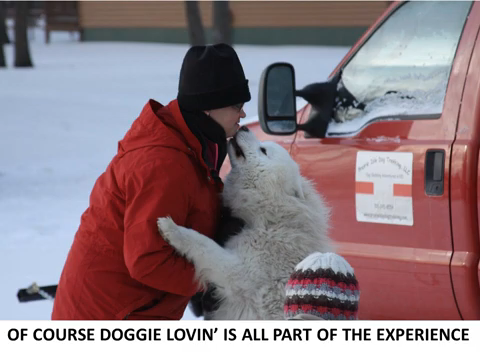
Helen L. Corlew runs a team of Samoyeds, Alaskan malamutes and Alaskan huskies. I am a Tellington TTouch practitioner and use this mode of work with training and living with my dogs.
Helen Corlew founded Prairie Isle Dog Trekking in Petersburg, North Dakota in 2010, and has spent the fifteen years since doing something most people only read about: teaching real dog sledding on real prairie terrain, at the edge of a landscape that doesn’t apologize for being difficult.
She is not a weekend enthusiast. She harnesses working dogs in January cold, trains handlers who have never touched a sled, and has built one of the only hands-on mushing education programs on the Northern Great Plains — from a single address on Highway 2, with no marketing budget and no shortcuts.
Her writing on Prairie Isle Dog Trekking reflects the same philosophy. Whether she is covering trail safety across the Rockies, breed behavior in extreme conditions, or what it actually takes to trek with a dog in the Alps, Helen writes from the position of someone who has done the work before writing the sentence.
She lives and runs dogs in Nelson County, North Dakota.
Kindly follow me on Social Media!


