


The lip curl was so small I almost missed it. A father had his hand on Maple’s head, pressing down the way people do when they want a dog to hold still for a photo, and Maple’s lip went up maybe a quarter inch on the left side and came back down before the shutter clicked. The father never saw it. His daughter didn’t see it. I saw it and said nothing in that moment, and that is the thing I’ve gone back to more than once.
Maple was fine. She’s been working with groups for six years and she is, by any measure, a steady dog. But she told me something in that quarter inch that I filed away and kept thinking about, which is that the signals are always there and most people have never been taught to see them.
Now there are studies. Papers. Scientists in university settings who have attached cameras to dogs on hiking trails and measured cortisol in saliva samples and written up their findings in language that will eventually get condensed into an article with a headline containing the word “suffering.” I read one of those last week. I didn’t disagree with the findings. What I disagreed with was the surprise.
The prairie in February gives you nothing to hide behind. No trees, no terrain, no shelter from what’s coming across the flats. What you get is clarity. A dog’s body in that kind of exposure reads like a weather instrument. You learn to see tail carriage and ear position and the specific way a dog’s weight shifts backward when it’s uncertain, the way you learn to read clouds. Not because someone handed you a framework. Because you had to.
What the studies are finding, the elevated stress hormones, the suppressed behavior, the signs of discomfort that owners consistently rate as happiness or neutrality, is not a new problem. It’s a newly measured one. Dogs have been telling people they were struggling for as long as people have been taking dogs places. The people just weren’t reading it.
I changed how I run orientations after a school group came out seven years ago and one of the kids, maybe nine years old, pointed at Koda and said he looked nervous. She was right. Koda was nervous, loud group, cold start, more chaos than I’d managed well that morning. I had been watching him and thinking he was on the edge of fine and this child who had never touched a working dog in her life read him in thirty seconds.
She saw it because nobody had told her yet not to. Adults talk themselves out of what they’re seeing in animals all the time because the alternative is inconvenient. The alternative means the dog doesn’t want to do the thing. Means the hike ends or doesn’t start. Means the plan changes.
Scientists say you should watch for panting beyond the level of exertion, for yawning that isn’t sleepiness, for the dog that checks in with you more than usual or not at all, for the tail that’s moving but not moving right. These are real signals. They’re also signals working dog handlers have been cataloguing in their heads for generations without needing a peer-reviewed framework to confirm what they see.

What the research is actually useful for is the people who need permission to believe what they’re watching. There are a lot of those people. They need a scientist to say it before they can act on it. That’s a real thing about how people work and I’m not dismissing it.
But somewhere between “studies suggest your dog may be stressed” and the actual moment on the trail when a dog’s ears go flat and its gait changes and it starts air-scenting anxiously, there is a gap that no article closes. That gap is attention. Sustained, practiced, ego-free attention to an animal that is communicating constantly and clearly in a language that has no words in it.
Minus fifteen, no wind yet, six dogs in harness, that four-second silence before everything moves. In that silence you are reading all of them at once. You are not thinking about the route or the group waiting or whether the sled is loaded right. You are only watching. After enough years of that, the watching doesn’t stop when the conditions get easier. It just becomes the way you look at dogs.
The dogs are not suffering mysteriously. They’re suffering visibly, in front of anyone paying attention without an agenda.
Watch the dog you have. Not the dog you want it to be on this trail, in this photo, on this particular Saturday you drove three hours to get to. The one in front of you, telling you what it’s telling you, right now.
That’s the whole science of it.

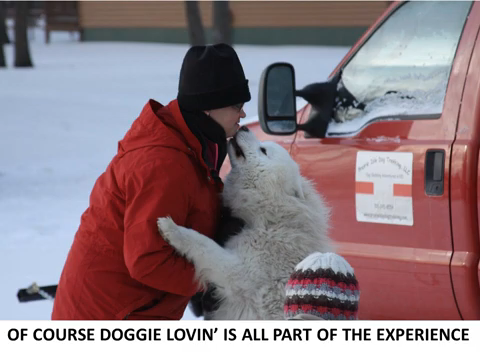
Helen L. Corlew runs a team of Samoyeds, Alaskan malamutes and Alaskan huskies. I am a Tellington TTouch practitioner and use this mode of work with training and living with my dogs.
Helen Corlew founded Prairie Isle Dog Trekking in Petersburg, North Dakota in 2010, and has spent the fifteen years since doing something most people only read about: teaching real dog sledding on real prairie terrain, at the edge of a landscape that doesn’t apologize for being difficult.
She is not a weekend enthusiast. She harnesses working dogs in January cold, trains handlers who have never touched a sled, and has built one of the only hands-on mushing education programs on the Northern Great Plains — from a single address on Highway 2, with no marketing budget and no shortcuts.
Her writing on Prairie Isle Dog Trekking reflects the same philosophy. Whether she is covering trail safety across the Rockies, breed behavior in extreme conditions, or what it actually takes to trek with a dog in the Alps, Helen writes from the position of someone who has done the work before writing the sentence.
She lives and runs dogs in Nelson County, North Dakota.
Kindly follow me on Social Media!


