
The first time a dog came back to me after I’d given up on her, I was elbow-deep in a frozen water bucket and not thinking about anything except breaking ice before feeding time. She just appeared at the kennel gate. Eight days. Minus-thirty for three of them. I stood there with wet arms going numb and looked at her and didn’t say a word.
That was Duchess, and she’s been dead six years now, and I still think about what she must have been doing those eight days more than I think about most things.
So when I read about Biscuit, the beagle mix from Billings who walked two hundred miles home through Montana after getting loose on a hunting trip, I didn’t say what most people said. Most people said miracle. Most people said impossible. I said: he knew something.
There’s a particular silence on the prairie before a team starts. The dogs are loaded, harnesses on, tug lines connected, and for about four seconds nobody moves and nobody makes a sound and you can hear the cold. Not wind, just cold, the way it presses against your ears like something with intention. Then one dog shifts weight and the whole line comes alive and that silence is gone for the rest of the day. What I know from standing in that silence is that the dogs are not waiting. They’re already somewhere else in their heads. Already running.
Biscuit was already running before his paws hit the ground.
Two hundred miles is not a number that means anything in the abstract. Walk it sometime. Walk it in October in Montana, where the temperature drops twenty degrees between afternoon and dark and the terrain doesn’t care what you brought with you. He crossed rivers. He crossed highway corridors. He navigated country where the landmarks shift with snowfall and the smells compress and flatten in the cold. He did this for weeks. Alone.
People keep using the word instinct like it settles something. Like instinct is a simpler explanation than intelligence. It isn’t. What Biscuit did required sustained decision-making: when to move, when to shelter, where water was, how to read the wind. I’ve watched dogs make those calculations in real time on trail and I don’t have a tidy word for what it is they’re doing, but it isn’t automatic. Nothing that lasts two hundred miles is automatic.

I had a dog named Cedar who got loose during a school group visit. Gate latch problem, my fault, entirely my fault. She covered ground I couldn’t have predicted, crossed two county roads and a frozen creek, and came back smelling like something I never identified. Forty minutes. I know she saw more of that country in forty minutes than I could have. They move through the world differently than we do. They’re receiving information we don’t have instruments to measure.
Here’s what I think happened with Biscuit, and I’m not guessing at the miracle part. I’m guessing at the mechanics. He had a fixed point. Home wasn’t a concept for him. It was a specific location made of specific smells and sounds and the particular weight of familiar air. He was moving toward a thing that was as real to him as the ground under his feet. The two hundred miles between him and that thing was just distance. Dogs understand distance. They do not understand giving up.
My hands stop working before I know they’ve stopped. That’s minus twenty: you reach for a buckle and your fingers are already gone and you didn’t feel them leave. No warning. No negotiation. Just absence where function used to be.
Biscuit walked through that kind of country, probably several nights of it, and he didn’t turn around.
I don’t know what to call that. Neither does anyone else. But I’ve been around enough working dogs long enough to know it’s not nothing. It’s not luck and it’s not miracle and it’s not instinct in the way people mean when they say instinct to mean something lesser than thought.
It’s a dog who knew where he was going and went.

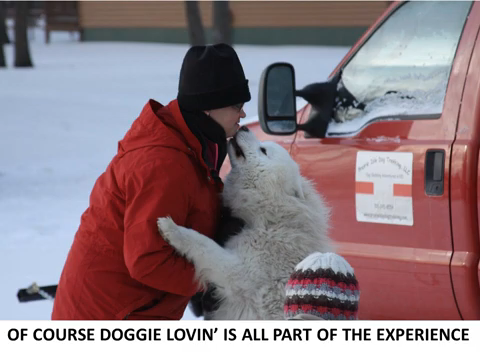
Helen L. Corlew runs a team of Samoyeds, Alaskan malamutes and Alaskan huskies. I am a Tellington TTouch practitioner and use this mode of work with training and living with my dogs.
Helen Corlew founded Prairie Isle Dog Trekking in Petersburg, North Dakota in 2010, and has spent the fifteen years since doing something most people only read about: teaching real dog sledding on real prairie terrain, at the edge of a landscape that doesn’t apologize for being difficult.
She is not a weekend enthusiast. She harnesses working dogs in January cold, trains handlers who have never touched a sled, and has built one of the only hands-on mushing education programs on the Northern Great Plains — from a single address on Highway 2, with no marketing budget and no shortcuts.
Her writing on Prairie Isle Dog Trekking reflects the same philosophy. Whether she is covering trail safety across the Rockies, breed behavior in extreme conditions, or what it actually takes to trek with a dog in the Alps, Helen writes from the position of someone who has done the work before writing the sentence.
She lives and runs dogs in Nelson County, North Dakota.
Kindly follow me on Social Media!