
The thing about a dog that greets every stranger like a reunion is that you can’t tell when it’s running on empty.
Scout did this. Third dog I ever kept for more than a season, a mixed breed with retriever somewhere in her, and she had that particular golden disposition that made every person who came through feel chosen. I’d be pulling harnesses off the fence in the morning, that cold nylon smell, frost on the clips, and Scout would already be at the gate watching the driveway for whoever might show up, leaning forward like the day had already promised her something. Every person who arrived got the full version of her: leaning in, tail going, eyes soft, giving everything she had. For the first two years I read that as happiness because it looked exactly like happiness. A vet mentioned something once about chronic social stress in high-contact dogs, the way the body keeps performing the behavior long after the animal has stopped finding it easy, and I went home and watched Scout differently for a week and understood I’d been misreading her for two years.
That’s not a comfortable thing to know about yourself.
I thought about Scout when I read about Teddy.
Teddy is a golden retriever who has hiked with twelve hundred strangers. That’s the number attached to his name now. Twelve hundred first dates, arranged through Tinder, each one showing up to walk a trail with this dog while they figure out if they want to see the person holding his leash again. Teddy’s owner built the whole thing around him deliberately. The dog is the icebreaker. The dog is the reason people swipe right.
The number is what stopped me. Not twelve. Not fifty. Twelve hundred.
A golden retriever is built for social contact in a way most breeds aren’t. The disposition is real, bred in deep, not a performance. But twelve hundred strangers means twelve hundred sets of hands, twelve hundred unfamiliar body chemistries, twelve hundred moments of a dog doing the work of making a human feel at ease. Goldens will do that work without complaint. That’s the problem with using them for it.


Teddy’s owner is not cruel. That’s what I had to sit with, because it would be simpler if he were. He’s lonely, or was, or wanted something to say yes to him, and he found that a dog on a trail makes people warmer and more honest than they’d otherwise be. That part is true. I’ve watched it happen a hundred times with first-timers who come out here stiff and uncertain and then something shifts the moment a dog leans against their leg without being asked.
Dogs close the distance humans can’t close for themselves. The question is whether closing it twelve hundred times is something the dog agreed to.
Teddy can’t tell you when he’s had enough. He’ll show up for the twelve hundredth hiker with the same open face he had for the first one, because that’s what goldens do, and because nothing in his nature will let him signal the cost in a language the owner is looking for. The owner will read the wagging tail and call it love, and it is love, and it’s also labor, and the dog will never be able to explain the difference.
You stop the sled out here when a dog tells you to stop, even if you didn’t hear it say anything, even if all it did was shift its weight in a way that wasn’t quite right. You learn to read that. You build the habit of looking before the signal gets loud.
Teddy’s owner never built that habit. Probably nobody told him he needed to.
The dog will keep showing up. That’s the truest thing about dogs. They keep showing up long after you’ve stopped deserving it.

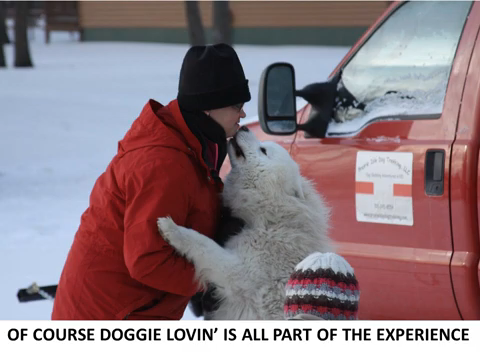
Helen L. Corlew runs a team of Samoyeds, Alaskan malamutes and Alaskan huskies. I am a Tellington TTouch practitioner and use this mode of work with training and living with my dogs.
Helen Corlew founded Prairie Isle Dog Trekking in Petersburg, North Dakota in 2010, and has spent the fifteen years since doing something most people only read about: teaching real dog sledding on real prairie terrain, at the edge of a landscape that doesn’t apologize for being difficult.
She is not a weekend enthusiast. She harnesses working dogs in January cold, trains handlers who have never touched a sled, and has built one of the only hands-on mushing education programs on the Northern Great Plains — from a single address on Highway 2, with no marketing budget and no shortcuts.
Her writing on Prairie Isle Dog Trekking reflects the same philosophy. Whether she is covering trail safety across the Rockies, breed behavior in extreme conditions, or what it actually takes to trek with a dog in the Alps, Helen writes from the position of someone who has done the work before writing the sentence.
She lives and runs dogs in Nelson County, North Dakota.
Kindly follow me on Social Media!