
Paw checks are the last thing I do before I put a team away for the night. Right rear, left rear, right front, left front. I run my thumb along each pad, check the webbing between toes for ice balls, look for cracking or raw spots or anything that wasn’t there this morning. Fifteen dogs. Sixty paws. I do it without thinking, the way you do anything you’ve done ten thousand times, and I was doing it last February when my neighbor came out to the yard and told me about the man who walked the Pacific Crest Trail barefoot.
His Malamute too, she said. The whole thing.
I finished the paw I was on before I answered her.
The human part I can hold at a certain distance. Barefoot on 2,650 miles of trail is a choice a person makes with their own body, their own nerve endings, their own tolerance for what that terrain does to unprotected skin over time, and I have no particular argument with a person deciding to be hard on themselves. North Dakota winters clarify what the human body can actually survive versus what it just finds uncomfortable. Those are different categories. I respect the distinction.
But the Malamute.
I know Malamutes. Not as well as I know my Siberians, but well enough. They are built for cold and load and distance. Their pads are thick, the structure designed for work. I don’t boot my dogs in cold conditions unless the temperature drops to where ice crystallizes sharp enough to cut, or when we’re running on salted road surfaces. Even then some of my dogs pull the booties off inside a mile because they hate them and their feet are fine without them. So I’m not someone who thinks dogs need permanent paw protection. I’m not coming at this soft.
What stopped me was the desert.
The PCT runs through the Mojave. It runs through sections of Southern California where exposed rock surface temperatures in summer exceed a hundred and forty degrees. A human going barefoot on that rock is making a choice that registers pain immediately. He can step off. He can stop. A dog going barefoot on that same rock is running on pads that will blister and split and keep going because that’s what dogs do. They keep going. That is not toughness. That is the absence of a choice.

I’ve pulled dogs off trail for less. I’ve ended a run because one dog’s gait shifted by a fraction and I didn’t know why yet, and I wasn’t willing to find out the hard way. That’s not excessive caution. That’s what you owe an animal that cannot tell you when something crosses from hard into wrong.
The man gave interviews. He talked about the dog’s feet, said the dog toughened up, said there were hard sections and they got through them. Maybe that’s true. I can’t see the dog’s paws from here. What I can see is that the story got told as an adventure. Two barefoot travelers, man and dog, free on the trail together, and the framing did what that kind of framing always does, which is to make the dog’s participation look like a choice.
It was not a choice.
There’s a sound a dog makes when a tug line goes slack and the load disappears. Relief isn’t the right word for it. It’s more neutral than relief. It’s just a dog recalibrating to new conditions, which is all a dog can do. Recalibrate to whatever conditions it’s given. A Malamute on the PCT recalibrates to whatever its person decides. Hot granite. Volcanic rock. Sand in August. It recalibrates and keeps moving because keeping moving is what it knows.
Right front, left front. The last two paws on the last dog tonight, a seven-year-old female named Grit who runs wheel and has pads like boot leather from a decade of prairie trail. She stood still in the dark outside the kennel and let me finish without moving, the way she always does. Patient. Breath clouding in the cold.
She doesn’t get a vote on the distance or the surface. What she gets is someone paying close attention to what the work costs her.
That’s the whole job, and it doesn’t stop being the job because the backdrop is prettier.

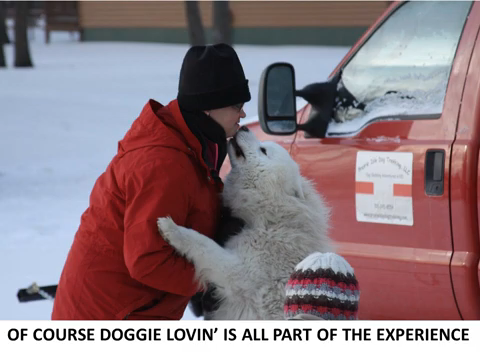
Helen L. Corlew runs a team of Samoyeds, Alaskan malamutes and Alaskan huskies. I am a Tellington TTouch practitioner and use this mode of work with training and living with my dogs.
Helen Corlew founded Prairie Isle Dog Trekking in Petersburg, North Dakota in 2010, and has spent the fifteen years since doing something most people only read about: teaching real dog sledding on real prairie terrain, at the edge of a landscape that doesn’t apologize for being difficult.
She is not a weekend enthusiast. She harnesses working dogs in January cold, trains handlers who have never touched a sled, and has built one of the only hands-on mushing education programs on the Northern Great Plains — from a single address on Highway 2, with no marketing budget and no shortcuts.
Her writing on Prairie Isle Dog Trekking reflects the same philosophy. Whether she is covering trail safety across the Rockies, breed behavior in extreme conditions, or what it actually takes to trek with a dog in the Alps, Helen writes from the position of someone who has done the work before writing the sentence.
She lives and runs dogs in Nelson County, North Dakota.
Kindly follow me on Social Media!