


What Alaska Doesn’t Own
The harness had been outside since Tuesday. When I picked it up Thursday morning the frozen nylon smell hit me before I’d even gotten the barn door fully open, that particular cold-plastic-and-dog-funk that means the temperature dropped hard overnight and stayed there. My lead dog Kopek was already watching me from her box, ears up, the whole front half of her body leaning forward even though she hadn’t moved her feet. She knew. They always know before you do.
I’d been reading the magazine piece the night before. The one about Alaska. The mushers up there trying to save something. Photographs of the Yukon, the Iditarod trail, men and women with weathered faces talking about tradition while the journalist nodded along. I don’t begrudge them the coverage. But I kept waiting for something in that piece to feel true, and it didn’t, not fully, and I’ve been trying to figure out why since.
Here’s what happened the first winter I took out a school group by myself. Forty below with wind chill, which I told the teacher twice and she still brought fourteen third-graders in cotton hoodies under their puffy coats. Cotton kills. I don’t say that for effect. I say it because it’s a fact the same way two plus two is a fact. We got a quarter mile out and one of the boys started crying, not from cold yet, just from the scale of it, the flatness, the way Highway 2 disappeared behind us and there was nothing in any direction but white and sky and the sound of twelve dogs working. His teacher looked at me with eyes that said fix this and I thought: I cannot fix what the land is doing to him right now. That’s the land’s job. My job is to make sure he gets back.
I turned the team around. No drama. The boy stopped crying about thirty seconds into the return run because the dogs pulled his attention somewhere useful, somewhere outside himself, and by the time we got back he was asking if he could hold the towline. He could not. But I let him stand next to Kopek while I unharnessed her, and she turned and put her nose against his ear, and that was the thing he wrote about in the thank-you card his class sent two weeks later.
The magazine piece kept talking about disappearance. The death of a culture. And I understand the alarm, I do, but there’s something off in the framing that bothered me enough that I’m writing this down now. The idea that sled dog culture lives in Alaska, that it belongs to a geography, that what’s being lost is something up there in the tundra that we might run out of. That’s not what I see.

What I see is a twelve-year-old girl in a borrowed balaclava learning that her hands stopped working without her noticing. She’s trying to tie off the gangline and the knot isn’t happening and she looks up at me confused, and I say: that’s frostbite threat, that’s what it feels like right before it gets serious, remember this feeling. She remembers it. I watch it land on her. That’s not disappearing. That’s being made, right here on flat North Dakota prairie where there’s no scenery to distract you from the actual education.
The Alaskan mushers in that piece are doing something real. I’m not saying otherwise. But the framing bothers me, the idea that culture is a thing that lives in one place and can die there. Minus fifteen and the dogs are lined out and the gangline is tight and the silence before a run is a specific silence, different from every other silence, the whole team holding something in their bodies that’s about to become motion. That silence exists in Petersburg. It exists in whatever frozen flat place has working dogs and people willing to stand in it.
The boy in the cotton hoodie is in high school now. His mom sent me a message last winter. He wants to come back with his own kids someday.
That’s not a culture racing toward its end. That’s a culture finding whoever it was always going to find, one frostbite lesson at a time, in whatever cold place still has the nerve to be honest about what it costs.

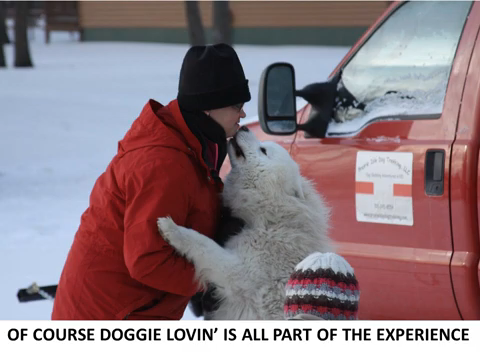
Helen L. Corlew runs a team of Samoyeds, Alaskan malamutes and Alaskan huskies. I am a Tellington TTouch practitioner and use this mode of work with training and living with my dogs.
Helen Corlew founded Prairie Isle Dog Trekking in Petersburg, North Dakota in 2010, and has spent the fifteen years since doing something most people only read about: teaching real dog sledding on real prairie terrain, at the edge of a landscape that doesn’t apologize for being difficult.
She is not a weekend enthusiast. She harnesses working dogs in January cold, trains handlers who have never touched a sled, and has built one of the only hands-on mushing education programs on the Northern Great Plains — from a single address on Highway 2, with no marketing budget and no shortcuts.
Her writing on Prairie Isle Dog Trekking reflects the same philosophy. Whether she is covering trail safety across the Rockies, breed behavior in extreme conditions, or what it actually takes to trek with a dog in the Alps, Helen writes from the position of someone who has done the work before writing the sentence.
She lives and runs dogs in Nelson County, North Dakota.
Kindly follow me on Social Media!


