


The dog’s front left pad had split clean down the center, and I didn’t catch it until we were back at the truck.
Not dramatic. Kestrel barely favored it, which is exactly the problem with dogs. I’d run that route a hundred times and I got comfortable. Prairie doesn’t care about comfortable. The ground was hard-packed, wind-scoured, the kind of surface that looks like nothing until it takes something from you. I pulled her bootie off and there it was: a clean split, edges already going white, and she just stood there looking at me like she was waiting for directions.
That split pad comes back to me when I read about what’s coming out of the popular trail systems now. The Appalachians. Colorado high country. Zion’s sandstone corridors. The Pacific Coast trails that fill up in summer like parking lots with views. Veterinarians are flagging it in earnest: overheated dogs, lacerated pads on quartzite and volcanic rock, GI trouble from trail water nobody tested, dogs finishing hikes with blood in their paws or not finishing at all.
Not surprised. Not alarmed, either, the way the articles seem to want you to be. What I am is tired of watching people misread dogs.
Kestrel’s split pad was March, minus eight, hard crust after a freeze-thaw cycle. But the misreading is the same in July on exposed granite in Colorado. Dogs don’t tell you they’re done. They tell you they were done twenty minutes ago by collapsing, or by a gait shift so subtle you’d have to know that specific dog to catch it. Most people don’t know their specific dog. They know a version of their dog: on the couch, in the yard, maybe on a neighborhood walk. They take that dog to a fourteen-mile trail with fifteen hundred feet of elevation gain and they get surprised.
The veterinarian warnings focus mostly on heat. Flat-faced breeds pushed past their design specs on exposed high-altitude trails where pale stone reflects sun and the temperature swings forty degrees between morning and afternoon. Pad burns. Foxtails in ears and eyes on California coastal trails. Blue-green algae in the lakes where every dog wants to drink at mile eleven because they’ve been rationed wrong.
All of that is real. None of it is the whole problem.


The whole problem is simpler and harder to fix. You have to know your dog like terrain. Not like a pet. Like terrain: something with limits you’ve mapped by paying attention over a long stretch of time, something that fails in ways that are specific and non-negotiable. My lead dogs, I know their water schedules the way I know the weather window for a long run. I know what Dag’s ears do when he’s borderline. I know Wren will push through pain before she’ll show it, because she was that way from six months old and nothing has changed. I built those maps slowly. They took mistakes to build.
A family that owns a golden retriever and hikes twice a year hasn’t built that map. Nobody told them they needed to. The outdoor industry sold them a leash, maybe some booties, a matching dog pack with water bottles, and the implicit guarantee that dogs are built for this.
Some dogs are. Some days.
The frozen nylon smell of a harness left outside overnight: you pull it off the hook and it’s stiff and cold and it smells like work, serious work, and you understand that harness was earned. By a dog that’s been assessed, conditioned, matched to the task. By a human who’s watched that dog long enough to have an opinion worth trusting.
Most people hiking those popular trails in July with a dog they’ve owned for two years haven’t done that assessment. They’ve done the purchase. It’s not cruelty. It’s not stupidity.
It’s just the gap between loving a dog and knowing one. That gap is where dogs get hurt.

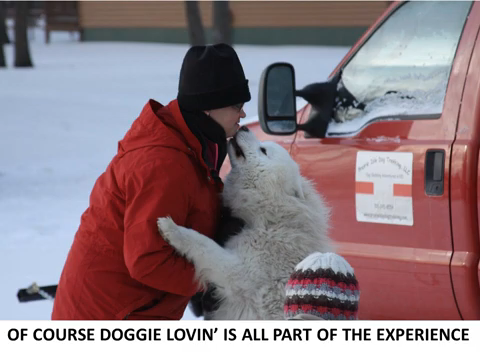
Helen L. Corlew runs a team of Samoyeds, Alaskan malamutes and Alaskan huskies. I am a Tellington TTouch practitioner and use this mode of work with training and living with my dogs.
Helen Corlew founded Prairie Isle Dog Trekking in Petersburg, North Dakota in 2010, and has spent the fifteen years since doing something most people only read about: teaching real dog sledding on real prairie terrain, at the edge of a landscape that doesn’t apologize for being difficult.
She is not a weekend enthusiast. She harnesses working dogs in January cold, trains handlers who have never touched a sled, and has built one of the only hands-on mushing education programs on the Northern Great Plains — from a single address on Highway 2, with no marketing budget and no shortcuts.
Her writing on Prairie Isle Dog Trekking reflects the same philosophy. Whether she is covering trail safety across the Rockies, breed behavior in extreme conditions, or what it actually takes to trek with a dog in the Alps, Helen writes from the position of someone who has done the work before writing the sentence.
She lives and runs dogs in Nelson County, North Dakota.
Kindly follow me on Social Media!


