

Walking the Camino de Santiago with a dog is permitted on all major routes but requires advance accommodation planning, veterinary documentation, and route selection based on the dog’s size and daily distance capacity. An estimated 3,000–5,000 pilgrims complete sections of the Camino with dogs each year, according to the Pilgrim’s Office in Santiago de Compostela.
What Is the Camino de Santiago With a Dog?
The Camino de Santiago with a dog is the act of completing one or more sections of the historic pilgrimage routes leading to the Cathedral of Santiago de Compostela in Galicia, Spain, while travelling with a dog as a trail companion. The Camino network spans over 3,200 km (1,988 miles) across multiple countries, including Spain, Portugal, France, and Germany. For the previous guide in this series, see Hiking the Appalachian Trail with a Dog: 9 Rules, Permit Requirements, and Section Guide.
Dogs on the Camino face 4 logistical challenges not encountered by solo pilgrims:
- Albergue access restrictions — the majority of public pilgrim hostels (albergues) do not permit dogs indoors
- Border documentation — dogs crossing from France, Portugal, or other EU countries require valid EU pet passports and rabies vaccination certificates
- Daily distance management — standard Camino stages average 20–25 km (12–15 miles) per day, exceeding safe limits for many dog breeds
- Heat exposure — the Meseta section of the Camino Francés crosses open plateau terrain with temperatures reaching 38°C (100°F) in July and August
What Are the Best Camino de Santiago Routes for Dogs?
The 3 best Camino de Santiago routes for dogs are the Camino Primitivo, the Camino del Norte, and the Camino Portugués. Each route offers cooler temperatures, natural terrain, and lower pilgrim traffic than the Camino Francés, reducing heat stress and behavioral triggers for trail dogs.
| Route | Total Distance | Terrain Type | Average Daily Stage | Dog Suitability |
|---|---|---|---|---|
| Camino Primitivo | 320 km (199 miles) | Mountain and forest | 20 km (12 miles) | High |
| Camino del Norte | 825 km (513 miles) | Coastal and forest | 22 km (14 miles) | High |
| Camino Portugués | 610 km (379 miles) | Rural and coastal | 20 km (12 miles) | High |
| Camino Francés | 780 km (485 miles) | Open plateau and farmland | 24 km (15 miles) | Moderate |
| Camino Inglés | 120 km (75 miles) | Coastal and rural | 20 km (12 miles) | High |
Table: Camino de Santiago route comparison for dog suitability, including distance, terrain type, and average daily stage.
The Camino Inglés is the shortest certified route that qualifies for a Compostela certificate (minimum 100 km on foot). It suits dogs with limited trail conditioning or owners completing their first Camino with a dog.
What Documents Does a Dog Need for the Camino de Santiago?
A dog walking the Camino de Santiago from outside Spain needs 4 documents: a valid EU pet passport, proof of rabies vaccination, a microchip registration certificate, and an Echinococcus tapeworm treatment record if entering Spain from outside the EU.
Document requirements by country of origin:
- EU countries (France, Portugal, Germany): EU pet passport with up-to-date rabies vaccination and microchip registration
- United Kingdom: Animal Health Certificate (AHC) issued within 10 days of travel; rabies vaccination required at least 21 days before entry
- United States and Australia: Rabies vaccination, USDA/AQIS-endorsed health certificate, and 21-day post-vaccination waiting period before EU entry
All dogs must be microchipped to ISO standard 11784/11785 before travel. Spain’s Animal Welfare Law (2023) requires microchipping for all dogs in public spaces. Non-compliance carries fines of up to €600.
Does a Dog Need a Rabies Vaccination for the Camino de Santiago?
A dog needs a valid rabies vaccination to enter Spain, administered at least 21 days before the travel date and recorded in an EU pet passport or equivalent travel document. Rabies vaccination must remain current throughout the duration of the Camino.
Confirm vaccination validity with a licensed veterinarian 4–6 weeks before the planned start date. Expired rabies vaccinations result in denial of entry at Spanish border control points.
Where Can You Stay With a Dog on the Camino de Santiago?
Dogs on the Camino de Santiago are accommodated in 3 types of lodging: private albergues with pet policies, rural guesthouses (casas rurales), and camping areas along the route.**
Public albergues operated by the Xunta de Galicia and municipal councils do not permit dogs. Private albergues apply individual pet policies. Confirm dog acceptance, fees, and sleeping arrangements before arrival.
Recommended accommodation strategy for the Camino with a dog:
- Book 2–3 days ahead — dog-friendly private albergues and casas rurales fill faster than standard pilgrim accommodation, particularly in July and August
- Use the Gronze.com or Buen Camino app — both platforms filter dog-friendly accommodation by route and stage
- Carry a lightweight tent — provides a guaranteed sleeping option on stages where dog-friendly accommodation is unavailable
- Contact albergues directly by phone — online listings are not always updated; phone confirmation reduces arrival refusals
Average nightly cost for dog-friendly private albergues ranges from €15–€35 per person. Casas rurales average €40–€80 per night for a private room.
How Do You Manage a Dog’s Daily Distance on the Camino de Santiago?
Manage a dog’s daily Camino distance by capping stages at 18–22 km (11–14 miles), splitting longer official stages into 2 days, and building a 3-week conditioning program before the start date.
Standard Camino stages are designed for human pilgrims and average 20–25 km (12–15 miles) per day. A dog covering this distance daily requires a minimum of 6 weeks of pre-Camino conditioning.
Follow this 3-phase conditioning plan:
- Phase 1 (Week 1–2): Walk 5–8 km (3–5 miles) daily on varied terrain including gravel, grass, and inclines of 3%–5%
- Phase 2 (Week 3–4): Increase to 10–15 km (6–9 miles) per session with a weighted dog backpack at 10% of body weight
- Phase 3 (Week 5–6): Complete 2 consecutive days of 18–20 km (11–12 miles) to simulate Camino stage demands
Reduce daily distance by 25% on stages with temperatures above 28°C (82°F). The Meseta section of the Camino Francés between Burgos and León averages 34°C (93°F) in July, making it the most heat-challenging section for dogs on the entire network.
What Gear Does a Dog Need for the Camino de Santiago?
A dog needs 7 essential gear items for the Camino de Santiago: a no-pull harness, 6-foot trail leash, EU pet passport document pouch, dog water bottle, collapsible bowl, dog booties for hot pavement sections, and a compact first-aid kit.
Camino-specific gear considerations include:
- Dog booties — urban entry sections into cities including Pamplona, Burgos, and Santiago de Compostela involve extended asphalt and cobblestone walking; surface temperatures on cobblestone reach 55°C (131°F) in summer
- Electrolyte supplement sachets — add to water on stages exceeding 20 km (12 miles) to replace minerals lost through sustained exertion
- Reflective vest or collar attachment — rural Camino sections cross active farm roads; reflective gear improves visibility at dawn and dusk
- Tick prevention treatment — the Camino passes through dense woodland and grassland in Galicia, Navarra, and northern Portugal; tick activity peaks between April and October
What Are the Rules for Dogs on the Camino de Santiago?
There are 8 rules for walking the Camino de Santiago with a dog:
- Keep the dog on a leash in all towns, villages, and albergue areas
- Carry valid travel documentation at all times
- Remove the dog from public albergues that prohibit animals; do not attempt entry
- Carry waste bags and remove all dog waste from the trail and accommodation grounds
- Prevent the dog from approaching livestock, particularly in Galicia and Navarra where cattle and sheep share trail corridors
- Carry proof of current flea and tick treatment; some accommodation providers request documentation
- Register with the Pilgrim’s Office in Saint-Jean-Pied-de-Port or your route’s starting point; note the dog’s presence in your pilgrim record
- Respect other pilgrims by keeping the dog at close heel distance on narrow trail sections
Camino de Santiago With a Dog: Final 8-Point Preparation Checklist
Walking the Camino de Santiago with a dog is achievable, rewarding, and increasingly common on routes outside the Camino Francés. Apply this 8-point checklist before departure:
- Obtain or update the EU pet passport at least 6 weeks before the start date
- Confirm rabies vaccination validity and 21-day pre-travel compliance
- Select a dog-appropriate route based on terrain, temperature, and daily stage distance
- Begin the 6-week conditioning program before the planned start date
- Book dog-friendly accommodation 2–3 days ahead throughout the route
- Pack all 7 essential dog gear items including booties for urban cobblestone sections
- Apply tick and flea prevention treatment 48 hours before departure
- Carry a lightweight tent as a contingency for stages with limited dog-friendly lodging
The Camino de Santiago with a dog rewards preparation with one of the most historically and scenically significant long-distance trail experiences available in Europe. Research from the University of Santiago de Compostela’s Institute of Pilgrimage Studies (2022) identifies dog-accompanied pilgrims as among the highest-rated groups for reported trail wellbeing scores, citing the companionship, pacing discipline, and daily routine that a dog imposes as direct contributors to a more consistent and enjoyable pilgrimage experience.
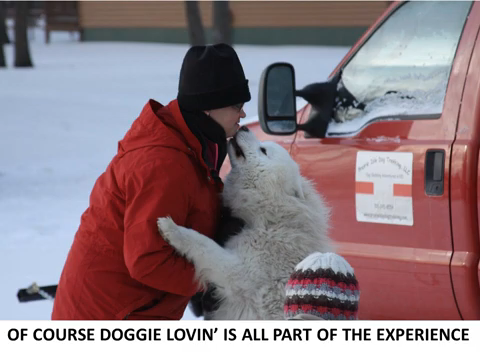
Helen L. Corlew runs a team of Samoyeds, Alaskan malamutes and Alaskan huskies. I am a Tellington TTouch practitioner and use this mode of work with training and living with my dogs.
Helen Corlew founded Prairie Isle Dog Trekking in Petersburg, North Dakota in 2010, and has spent the fifteen years since doing something most people only read about: teaching real dog sledding on real prairie terrain, at the edge of a landscape that doesn’t apologize for being difficult.
She is not a weekend enthusiast. She harnesses working dogs in January cold, trains handlers who have never touched a sled, and has built one of the only hands-on mushing education programs on the Northern Great Plains — from a single address on Highway 2, with no marketing budget and no shortcuts.
Her writing on Prairie Isle Dog Trekking reflects the same philosophy. Whether she is covering trail safety across the Rockies, breed behavior in extreme conditions, or what it actually takes to trek with a dog in the Alps, Helen writes from the position of someone who has done the work before writing the sentence.
She lives and runs dogs in Nelson County, North Dakota.
Kindly follow me on Social Media!
