

Twelve Dogs Running
The sound a dog makes when the tug line goes slack is not a big sound. It’s almost nothing, a soft exhalation of tension, and if you haven’t heard it a hundred times you won’t even register it as information. I heard it once on a Tuesday in February, conditions fine, trail packed, nothing complicated about the morning, and by the time I processed what I’d heard, the whole team had already felt it travel up the gangline like a question being asked in a language they were born knowing the answer to.
Nothing happened. I got it sorted in under a minute.
But I stood there afterward in the particular silence of flat prairie, no trees to hold the sound, no hills to give it shape, just me and eight dogs and the smell of cold metal and frozen nylon and my own breath, and I thought about what would have happened on different ground. Ground with somewhere to go.
So. Yellowstone.
Twelve dogs. Three hours. Rangers on foot and probably on radio and probably cursing, and somewhere out there in the thermal basin or the lodgepole or wherever they got to, a pack of sled dogs doing what sled dogs are built at the cellular level to do when the line goes slack and the handler is not where the handler is supposed to be.
I don’t know the handler. I’m not going to speculate about what went wrong. Something went wrong. It always does, and it’s never the thing you rehearsed for.
What I know is this. The piece got written like it was funny. Like it was a caper. Twelve dogs, three hours, some harried rangers, everybody fine, the internet loves it. And look, nobody got hurt. The dogs came back. So.
But I’ve been thinking about the moment it started. Not the chase. Before that.
I had a group out two winters ago, a school group, fourteen kids from Minot, and there was one boy who decided partway through the safety talk that he already understood what I was telling him, and his body showed it before his face did, the slight lean away, the eyes going to the dogs instead of staying on me, and I stopped mid-sentence and I looked at him and I said, the dogs know when you stop paying attention before you do. He looked back. Good. We kept going.
Because that’s the real gap. Not between experts and beginners. Between people who understand that working dogs are always reading the situation and people who think they’re managing animals that aren’t reading anything at all.
Sled dogs are not pets who happen to be wearing harnesses. They are not performing a role for you. They are doing a thing they were bred across centuries to do, and they are doing it with more focus and physical commitment than most humans will ever bring to anything, and when that focus finds no anchor, when the line goes slack and the handler is gone and there is suddenly open ground in every direction, they don’t get confused. That’s the part people miss. They don’t panic. They run.
Yellowstone is not Petersburg, North Dakota. Petersburg is flat and frozen and there is nowhere to go that isn’t eventually a farmstead or a county road. The dogs could run and they’d fetch up somewhere manageable. I have margin built into the geography. Some places don’t give you that.
You stand in the yard before a run and the dogs are vibrating, every one of them, the whole team a single held breath, and the cold is burning your nose the way it does at minus ten, not all the way down to metal yet but getting there, and what you are holding in that moment is not a group of animals waiting for your instruction. You are holding the agreement. That’s all it is. You and the dogs have an agreement about what happens next, and that agreement requires your full presence to exist.
Let the attention go, and you don’t have twelve dogs anymore.
You have twelve dogs running.
Three hours in Yellowstone is a good outcome. I mean that without any humor in it. The agreement broke and it cost three hours and some ranger overtime and probably some paperwork, and the dogs came home, and that’s the best version of that story. Most of the other versions don’t end that clean.
The line goes slack. After that, it’s just terrain.
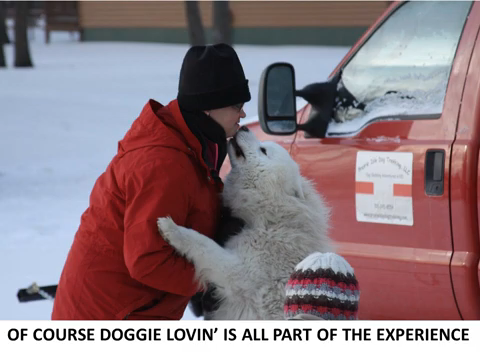
Helen L. Corlew runs a team of Samoyeds, Alaskan malamutes and Alaskan huskies. I am a Tellington TTouch practitioner and use this mode of work with training and living with my dogs.
Helen Corlew founded Prairie Isle Dog Trekking in Petersburg, North Dakota in 2010, and has spent the fifteen years since doing something most people only read about: teaching real dog sledding on real prairie terrain, at the edge of a landscape that doesn’t apologize for being difficult.
She is not a weekend enthusiast. She harnesses working dogs in January cold, trains handlers who have never touched a sled, and has built one of the only hands-on mushing education programs on the Northern Great Plains — from a single address on Highway 2, with no marketing budget and no shortcuts.
Her writing on Prairie Isle Dog Trekking reflects the same philosophy. Whether she is covering trail safety across the Rockies, breed behavior in extreme conditions, or what it actually takes to trek with a dog in the Alps, Helen writes from the position of someone who has done the work before writing the sentence.
She lives and runs dogs in Nelson County, North Dakota.
Kindly follow me on Social Media!
