
The story came across my phone the way those stories do, shared by three different people in the same morning with the same note attached: thought of you. A man in the Rockies. A blizzard. Declared dead by a search team that found the snow unbroken and turned back. His Siberian Husky had curled across his chest and stayed there for nineteen hours until a second team found them both alive, the dog lifting her head when she heard the snowmobiles coming.
I read it twice. Then I set my phone down and went out to do the morning feeding.
The dogs were loud the way they always are at feeding time, that specific high urgency that sounds like chaos but has an order to it if you know who’s who and where they stand. I moved down the line with the bucket and I was thinking about that Husky the whole time, not the man, the dog, and what it means that we keep being surprised by this.
A Siberian in a blizzard is not suffering. That needs saying plainly. The cold that kills an unprepared human is the cold a northern breed was built for, the minus-twenty kind that scours the inside of your nose clean and turns your exhaled breath to ice before it’s a foot from your face. She wasn’t enduring. She was doing what her biology and her bond both told her to do at the same time, and those two things happened to point in the same direction.
What I keep turning over is the declared dead part.
A search team looked at unbroken snow and made a call. That’s not a failure. In avalanche and blizzard recovery, time is the whole equation and you make decisions on incomplete information and sometimes the information is wrong and you live with that. But the dog didn’t make a decision. She didn’t calculate survival odds or weigh the resource cost of staying. She just stayed. The man was there and she was with him because he was there.
I had a dog named Ruger, years back, a big male, not a leader but one of the most physically capable dogs I’ve run. One February I had him paired with a younger dog on a training run and the younger dog stumbled and went down hard and the tug line went slack with that particular sound it makes, like something deflating, and Ruger stopped. Didn’t pull. Didn’t tangle. Just stopped and stood over the younger dog until I got there. No training for that. No command that covers it. He just read the situation and his answer was to cover it.
That’s not loyalty in the greeting-card sense. It’s something older and more functional than that, something that developed across thousands of years of animals and humans needing things from each other in conditions that didn’t forgive inattention.

The survival stories always frame the dog as hero. The headlines write themselves. And the dog did do a heroic thing, in the plain meaning of the word, she kept a living body warm when warmth was the difference. But the framing puts the dog outside of nature, makes her exceptional, turns it into a story about love conquering a blizzard, and that’s where it loses the actual truth.
She was exceptional in the way that all working dogs are exceptional, which is to say she was doing what she was, fully, without interruption, in the exact conditions that asked for everything she had.
I run beginners out here on open prairie where a weather change can find you fast and there’s no terrain to shelter behind and the horizon is the same in every direction and mistakes are just mistakes, no drama, just consequence. I tell people before we start: watch the dogs, not the scenery. The dogs know things first. They feel the weather shifting and they read the ground and they track sounds a quarter mile out and if you pay attention to what they’re paying attention to, you are significantly less at risk than you were five minutes ago.
That man in the Rockies had nineteen hours of a dog paying attention to him.
The people who shared the story with me meant it warmly and they weren’t wrong to. But what I want them to understand is that this isn’t a miracle. It’s a dog being a dog in the fullest sense, and the miracle, if there is one, is that we bred that animal and then mostly forgot what we bred it for.
She didn’t save him because she loved him. She saved him because she was there, and being there completely is what she was.

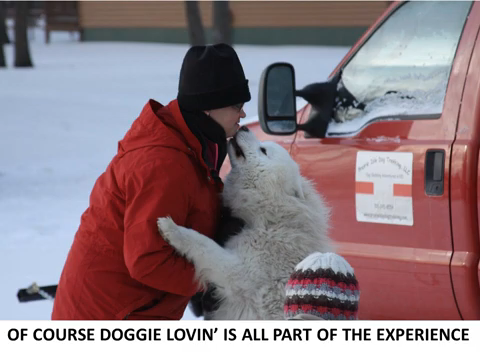
Helen L. Corlew runs a team of Samoyeds, Alaskan malamutes and Alaskan huskies. I am a Tellington TTouch practitioner and use this mode of work with training and living with my dogs.
Helen Corlew founded Prairie Isle Dog Trekking in Petersburg, North Dakota in 2010, and has spent the fifteen years since doing something most people only read about: teaching real dog sledding on real prairie terrain, at the edge of a landscape that doesn’t apologize for being difficult.
She is not a weekend enthusiast. She harnesses working dogs in January cold, trains handlers who have never touched a sled, and has built one of the only hands-on mushing education programs on the Northern Great Plains — from a single address on Highway 2, with no marketing budget and no shortcuts.
Her writing on Prairie Isle Dog Trekking reflects the same philosophy. Whether she is covering trail safety across the Rockies, breed behavior in extreme conditions, or what it actually takes to trek with a dog in the Alps, Helen writes from the position of someone who has done the work before writing the sentence.
She lives and runs dogs in Nelson County, North Dakota.
Kindly follow me on Social Media!