

Hiking with a dog requires preparation across 5 areas: health clearance, physical conditioning, gear selection, trail planning, and on-trail safety management. A 2020 study published in Anthrozoös confirms that dogs who hike regularly show lower cortisol levels and reduced stress-related behaviors compared to sedentary dogs.
What Is Hiking With a Dog?
Hiking with a dog is a planned outdoor walking activity on natural trails where a dog accompanies its owner over varied terrain and distances. It differs from casual walking in duration, elevation, and physical demand. Examples of hiking environments include mountain trails, forest paths, desert routes, and coastal cliffs. For the previous guide in this series, see Dog Hiking Trails California: 12 Best Routes, Regulations, and Seasonal Access Rules.
Hiking with a dog falls into 3 categories:
- Day hikes — Completed within a single day, typically 5 to 20 km
- Half-day hikes — Shorter outings of 2 to 8 km on moderate terrain
- Overnight hiking — Multi-day trails requiring campsite planning and extended supply carry
How Do You Prepare a Dog for Hiking?
Preparing a dog for hiking follows 4 sequential steps: veterinary clearance, fitness building, gear fitting, and trail familiarization.
Skipping preparation increases injury risk. The American Veterinary Medical Association (AVMA) recommends full health screening before any sustained trail activity, particularly for dogs under 18 months or over 7 years.
What Veterinary Checks Does a Dog Need Before Hiking?
A dog requires 5 veterinary assessments before its first hike:
- Joint and hip evaluation — Detects early dysplasia in breeds prone to musculoskeletal issues. Examples include German Shepherds, Labrador Retrievers, and Golden Retrievers.
- Cardiovascular screening — Confirms heart and lung capacity for sustained aerobic output
- Vaccination update — Leptospirosis, rabies, and Bordetella vaccinations are required before trail access in most regions
- Parasite prevention — Tick and flea treatments must be active at least 48 hours before trail entry
- Paw pad assessment — Identifies existing cracks, sensitivity, or conditions that worsen on rough terrain
At What Age Can a Dog Start Hiking?
Dogs are ready for moderate hiking at 18 months of age. Before 18 months, growth plates in the long bones remain open. High-impact trail activity during this period increases the risk of permanent joint damage. Short, flat walks of 20 to 30 minutes are appropriate for dogs between 8 and 18 months.
Senior dogs over 8 years require reduced trail intensity. Limit elevation gain to 150 metres per outing and restrict total distance to 8 km unless the dog maintains active conditioning.
How Do You Build a Dog’s Hiking Fitness?
Build a dog’s hiking fitness over 6 weeks using a progressive distance and elevation method.
Here is a 6-week conditioning schedule:
| Week | Daily Duration | Terrain Type | Elevation Gain |
|---|---|---|---|
| 1 | 20 minutes | Flat pavement or grass | None |
| 2 | 30 minutes | Flat with short inclines | Up to 30 m |
| 3 | 40 minutes | Gentle hills | Up to 60 m |
| 4 | 50 minutes | Mixed terrain | Up to 100 m |
| 5 | 60 minutes | Uneven trail surface | Up to 150 m |
| 6 | 75–90 minutes | Full trail simulation | 150–300 m |
Signs that a dog is progressing well include steady pace maintenance, normal breathing recovery within 5 minutes of rest, and consistent appetite after activity. Signs of overtraining include limping, reluctance to continue, and laboured breathing that persists beyond 10 minutes of rest.
What Gear Do You Need to Hike With a Dog?

Hiking with a dog requires 7 core gear items: a fitted harness, 2-metre leash, collapsible water bowl, dog backpack, protective boots, identification tag with GPS, and a dog-specific first aid kit.
Here is a full gear breakdown:
| Gear Item | Function | Key Specification |
|---|---|---|
| Fitted harness | Distributes leash force across chest | Back-clip design for trail use |
| 2-metre leash | Maintains control on shared trails | Non-retractable; fixed length |
| Collapsible water bowl | Portable hydration station | BPA-free silicone, minimum 500 ml |
| Dog backpack | Carries dog’s own supplies | Load limit: 25% of dog’s body weight |
| Protective boots | Guards paws against heat, rock, and debris | Rubber sole with ankle strap |
| GPS ID tag | Identifies and locates dog if separated | Waterproof, 48-hour battery life |
| Dog first aid kit | Treats trail injuries before veterinary care | See first aid section below |
Should a Dog Wear Boots While Hiking?
Dogs benefit from boots on 3 terrain types: hot asphalt, sharp rock, and snow or ice. Trail surface temperatures above 52°C cause paw burns in under 60 seconds. Rocky scree and shale cause lacerations on unprepared paws. Introduce boots at home for 10 to 15 minutes daily for 2 weeks before trail use. Dogs unaccustomed to boots show gait disruption for the first 5 to 10 minutes of wear.
How Do You Choose a Dog-Friendly Hiking Trail?
A dog-friendly hiking trail permits leashed dogs, provides water access points, and avoids protected wildlife breeding zones.
Evaluate every trail using 5 criteria before departure:
- Legal access — Confirm dogs are permitted. Over 40 national parks worldwide restrict dog access on designated routes.
- Trail grade — Match difficulty to the dog’s breed and fitness level. A trail with more than 500 metres of elevation gain per 10 km is classified as strenuous.
- Water sources — Identify reliable water points along the route or carry the full water requirement independently.
- Shade and canopy — Forested trails reduce ambient trail temperature by 5 to 10°C compared to exposed ridgelines.
- Surface type — Packed dirt and grass surfaces are preferable. Asphalt retains heat and accelerates paw pad wear over extended distances.
How Do You Research Dog-Friendly Trails?
Use 3 reliable sources to verify trail access for dogs:
- Official park or land authority websites — These carry current regulations and seasonal restrictions
- AllTrails database — Tags dog-friendly trails and includes user reviews noting specific access conditions
- Local hiking clubs — Provide real-time trail condition reports and seasonal dog access updates
How Much Water Does a Dog Need While Hiking?
A hiking dog requires 60 ml of water per kilogram of body weight per hour of activity. A 20 kg dog on a 4-hour hike needs approximately 4.8 litres of water.
Offer water every 15 to 20 minutes during active trail sections. Do not allow dogs to drink from stagnant ponds, puddles, or slow-moving streams. These water sources carry 4 common pathogens:
- Giardia lamblia — Causes severe gastrointestinal illness
- Leptospira bacteria — Leads to kidney and liver damage
- Cryptosporidium — Causes diarrhoea and dehydration
- Blue-green algae toxins — Cause liver failure within hours of ingestion
Carry treated or filtered water for the dog’s full calculated intake on every hike.
What Are the Signs of Dehydration in a Hiking Dog?
Dehydration in a hiking dog presents as 5 observable signs:
- Skin fold at the neck does not return to flat within 2 seconds when pinched
- Gums are dry or sticky rather than moist and pink
- Eyes appear sunken within the socket
- Urine is dark yellow or orange
- Dog slows pace, sits frequently, or refuses to continue
At the first sign of dehydration, stop hiking, provide water in small amounts every 5 minutes, and move the dog to shade. Seek veterinary care if symptoms do not resolve within 20 minutes.
What Are the Safety Rules for Hiking With a Dog?
Hiking with a dog safely requires leash management, wildlife awareness, heat monitoring, paw checks, and knowledge of emergency exit routes.
How Do You Manage a Dog on a Leash While Hiking?
Keep dogs on a fixed 2-metre leash throughout shared trail sections. A 2020 study in Biological Conservation found that off-leash dogs disturb wildlife at distances up to 100 metres from the trail edge, causing nest abandonment and herd displacement in protected areas.
Follow 4 leash management rules on trail:
- Maintain leash tension awareness — Prevent the leash from wrapping around legs on narrow switchbacks
- Shorten leash on descents — Control the dog’s speed on downhill sections to prevent joint impact injuries
- Use a hands-free leash on flat sections — Reduces fatigue on long hikes and allows better balance on uneven terrain
- Never tie a dog to a fixed object unsupervised — Dogs left tied on trails are vulnerable to wildlife, other dogs, and weather changes
How Do You Handle Wildlife Encounters While Hiking With a Dog?
Maintain a minimum distance of 50 metres from all wildlife observed on trail. Dogs trigger a predator response in many wild animals. Examples include deer, wild boar, mountain lions, and bears.
Follow these 4 steps during a wildlife encounter:
- Stop moving and speak calmly to the dog
- Shorten the leash to 30 cm from the collar
- Back away slowly without turning your back to the animal
- Report large predator sightings to the park authority after exiting the trail
What Should a Dog Hiking First Aid Kit Contain?
A dog hiking first aid kit contains 10 items for managing trail injuries before veterinary care is available.
The 10 essential items are:
- Antiseptic wound spray or chlorhexidine solution
- Sterile gauze pads — minimum 10 pieces
- Self-adhesive bandage wrap (Vetrap or equivalent)
- Blunt-tipped scissors
- Tick removal tool — fine-tipped forceps preferred
- Disposable gloves — 2 pairs minimum
- Emergency thermal blanket
- Sterile saline solution for eye and wound flushing
- Activated charcoal tablets — for suspected plant toxin ingestion (veterinary guidance required before use)
- Printed emergency card with nearest veterinary clinic address and contact number
What Hiking Etiquette Rules Apply When Hiking With a Dog?
Hiking etiquette with a dog follows 6 universal trail conduct standards:
- Yield to uphill hikers — Move the dog to the downhill side of the trail when yielding
- Pick up all waste — Dog faeces carry Toxocara canis and Campylobacter bacteria that contaminate soil and water within a 10-metre radius
- Ask before approaching other dogs — Not all trail dogs are socialized or non-reactive
- Keep the dog from approaching wildlife — Maintain the 50-metre international wildlife buffer standard
- Do not allow the dog to enter revegetation or restoration zones — These are marked with signage on managed trails
- Carry out all waste bags — Do not leave filled bags on trail for collection later; they are rarely retrieved and degrade slowly
How Do You Know When to Turn Back While Hiking With a Dog?
Turn back immediately when a dog shows any of 4 conditions: sustained limping, laboured breathing lasting more than 10 minutes after rest, refusal to move, or visible paw injury.
These 4 signals indicate the dog has reached its physical limit or sustained an injury:
- Limping on any leg — Indicates joint strain, paw laceration, or embedded debris. Inspect the paw immediately. Remove debris with forceps. If limping continues after debris removal, exit the trail.
- Breathing that does not slow after 10 minutes of rest — Indicates heat stress or cardiovascular strain. Move to shade, offer water, and exit.
- Refusal to walk — Dogs do not stop without cause. A dog that sits or lies down and will not move is communicating distress.
- Swollen joints or paws — Indicate trauma or acute inflammatory response. Do not continue hiking on a swollen limb.
Summary
Hiking with a dog is achievable through systematic preparation, appropriate gear, hydration management, and adherence to trail safety and etiquette standards. Veterinary clearance, a 6-week conditioning program, and trail selection based on 5 key criteria reduce injury risk and improve the experience for both dog and owner. Following water intake guidelines of 60 ml per kg per hour and recognizing the 4 signs that require trail exit ensures every hike ends safely.
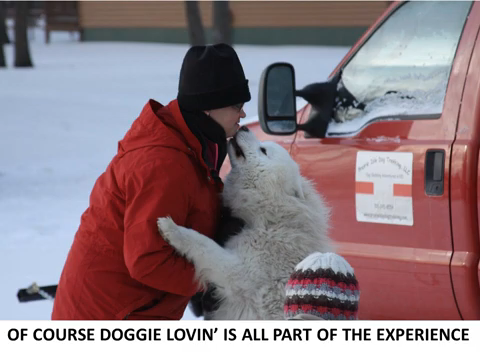
Helen L. Corlew runs a team of Samoyeds, Alaskan malamutes and Alaskan huskies. I am a Tellington TTouch practitioner and use this mode of work with training and living with my dogs.
Helen Corlew founded Prairie Isle Dog Trekking in Petersburg, North Dakota in 2010, and has spent the fifteen years since doing something most people only read about: teaching real dog sledding on real prairie terrain, at the edge of a landscape that doesn’t apologize for being difficult.
She is not a weekend enthusiast. She harnesses working dogs in January cold, trains handlers who have never touched a sled, and has built one of the only hands-on mushing education programs on the Northern Great Plains — from a single address on Highway 2, with no marketing budget and no shortcuts.
Her writing on Prairie Isle Dog Trekking reflects the same philosophy. Whether she is covering trail safety across the Rockies, breed behavior in extreme conditions, or what it actually takes to trek with a dog in the Alps, Helen writes from the position of someone who has done the work before writing the sentence.
She lives and runs dogs in Nelson County, North Dakota.
Kindly follow me on Social Media!
