

The tug line went slack mid-run and I knew before I looked that Fenwick had pulled up lame. Dropped out of his harness rhythm so quietly that the other dogs hadn’t registered it yet, just that slight drag, that half-second where the whole team’s cadence shifts and your hands feel it before your brain names it. I stopped the sled. Checked his left front. Nothing obvious. Ran my thumb along the tendon anyway. He watched my face the whole time, not the hand. That’s how you know they trust you. They look at your face.
I thought about that last March when I read the piece about the tech retreats in Alaska. The ones running billionaires through mushing experiences at ten thousand dollars a head. The writer called it a trend. I’d call it something else.
These are men who optimized everything until nothing surprised them. Who built systems so good at predicting outcomes that outcomes stopped being interesting. And now they’re paying serious money to stand on a sled in the Alaska Range and find out what happens when the variable they can’t control is a 55-pound animal with its own opinions about the trail ahead. I understand the appeal. I don’t understand what they think they’re buying.
The piece quoted one of them, a fund manager out of San Francisco, saying the dogs taught him to relinquish control. He said it like it was a philosophy. Like he’d arrived somewhere.
The cold up here doesn’t care what you’ve arrived at. Minus twenty burns different than minus five. At minus five it’s a surface thing, it sits on your skin and you manage it. At minus twenty it gets into the cartilage of your nose and stays there, and your hands stop working before you realize they’ve stopped, and whatever clarity you flew up here to find gets very simple very fast. Stay warm. Keep moving. Don’t make a bad decision.
I’ve put a lot of beginners on sleds. Farm families from Towner. A church group from Minot. A high school class that drove four hours on a Tuesday in January. None of them showed up with a prepared statement about relinquishing control. They showed up scared and cold and they listened because they had to. The dog didn’t care that they were nervous. The dog cared whether the line was taut.
That’s the thing nobody putting together a luxury mushing retreat is going to tell you. A working dog is not a teacher. It is not a mirror for your personal growth. It is an animal with a job, and the job requires you to be competent, not enlightened. The dogs I run have no interest in your net worth or your resting heart rate or the number of hours you’ve logged in a sensory deprivation tank. They want the harness fitted right. They want the commands clear. They want you to mean it when you say whoa.

The fund manager probably got some version of that on day two of his retreat, standing in a yard full of dogs who wouldn’t line out for him until he stopped performing calm and started being it. That’s real. That moment is real. But you can’t buy what it turns into. You can only take it home and either use it or forget it, and most people forget it before the plane lands.
Fenwick was fine, by the way. Bruised pad, nothing structural. I boosted him for the return run and he was annoyed about it the whole way back, ears flat, doing that stiff-legged protest trot that means he knows he’s being managed. I’ve never had a dog who argued more elegantly. We ran another six seasons together after that morning.
What the Alaska retreats are selling is the feeling of competence under pressure. That’s legitimate. That feeling is real and it is hard to manufacture and most of the things these men do for work stopped giving it to them years ago. I don’t begrudge them the search.
But the dogs don’t know they’re a product. And the cold doesn’t know it’s a backdrop.
That’s the part that will either teach you something or it won’t.

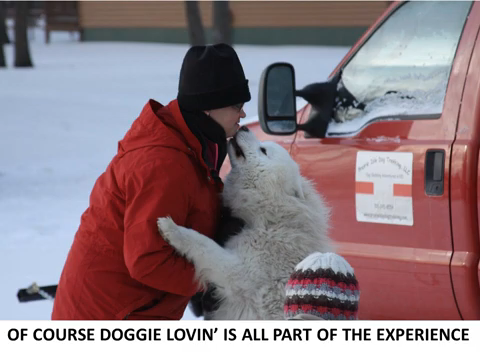
Helen L. Corlew runs a team of Samoyeds, Alaskan malamutes and Alaskan huskies. I am a Tellington TTouch practitioner and use this mode of work with training and living with my dogs.
Helen Corlew founded Prairie Isle Dog Trekking in Petersburg, North Dakota in 2010, and has spent the fifteen years since doing something most people only read about: teaching real dog sledding on real prairie terrain, at the edge of a landscape that doesn’t apologize for being difficult.
She is not a weekend enthusiast. She harnesses working dogs in January cold, trains handlers who have never touched a sled, and has built one of the only hands-on mushing education programs on the Northern Great Plains — from a single address on Highway 2, with no marketing budget and no shortcuts.
Her writing on Prairie Isle Dog Trekking reflects the same philosophy. Whether she is covering trail safety across the Rockies, breed behavior in extreme conditions, or what it actually takes to trek with a dog in the Alps, Helen writes from the position of someone who has done the work before writing the sentence.
She lives and runs dogs in Nelson County, North Dakota.
Kindly follow me on Social Media!


