

What the Catalog Doesn’t Weigh
The first harness I bought for Soot cost forty-two dollars and I’ve repaired it three times with a stitching awl and waxed thread and it fits him the way a good harness is supposed to fit, which is to say you can barely see it move when he moves. Last month a woman on a group run pulled out a harness for her dog that cost two hundred and nineteen dollars. I know because she told me. It had a handle on the back, two carabiner attachment points, a reflective chest panel, and a small fleece-lined pocket on the side that she said was for treats.
Her dog spent the first ten minutes of the run trying to reach the pocket.
I didn’t say anything. I showed her how to redirect him, got him focused on the trail, and we had a fine run. But I thought about that pocket for a long time afterward. Not with judgment. With something closer to recognition.
Two billion dollars. That’s what they’re saying the dog outdoor gear market is worth now, insulated booties and UV-blocking rash guards and hydration vests with bladders sized for a forty-pound animal. The think pieces are writing it as revolution, as the mainstreaming of dogs as full participants in outdoor life, as culture catching up to what dog owners already knew.
I’ve been outfitting dogs for the actual outdoors since 2010. I want to talk about what that means.
Cold is the first thing. Not the idea of cold, the magazine-photograph cold with a beautiful dog on a snowy ridge looking noble. The cold that gets into your hands before you know it’s gotten there, that particular moment when you reach to clip a line and your fingers close on nothing because the signal between your brain and your hand has gone quiet without announcing itself. I’ve had volunteers on this operation go numb in forty minutes at minus twelve without realizing it. Grown adults, healthy, dressed for it. They looked at their hands with genuine confusion.
The dogs don’t have that problem. The dogs are built for this. What they need from gear is fit and function and nothing else. A harness that doesn’t bind at the shoulder. Booties, when the ice is sharp, that stay on. That’s the whole list.
What the two-billion-dollar industry is selling is a different thing. It’s selling the feeling of readiness. The gear as proof that you take this seriously, that your dog is equipped, that you’ve done your part before you even get out of the parking lot. And I understand that feeling. I recognize it in the beginners who show up here. They’ve bought the thing. They’ve read the thing. They’re prepared in every way that can be purchased.

Then the team starts.
There’s a silence on flat prairie right before a run that has no equivalent anywhere. No echo, no trees to break it, just cold open space and eight dogs holding their breath in unison and the frozen nylon smell of the gangline and your own heartbeat sounding louder than it should. Into that silence, a two-hundred-dollar harness with a treat pocket is not an asset. It’s a conversation you’re having with yourself about a dog that isn’t listening to that conversation at all.
A dog out here needs you present. Gear doesn’t make you present. It can make you comfortable, which is not worthless, comfort extends your time outside and that matters. But the catalog doesn’t tell you what to do when the wind picks up and the temperature drops six degrees in forty minutes and the dog you dressed so carefully is pulling hard to the right for a reason you haven’t identified yet.
The reason, that day, was a loose fence post half-buried in a drift. The dog knew it was wrong before I saw it. She’d been reading the ground while I was managing my own cold hands, my own footing, my own effort to stay with the team.
The gear didn’t tell me that. She did.
What I watch in this industry isn’t cynical exactly. People love their dogs. That part is real. But love that expresses itself mostly through purchasing is still looking for something to do with its hands.
The dog already knows what it needs. It needs you to show up to the same trail it’s on.
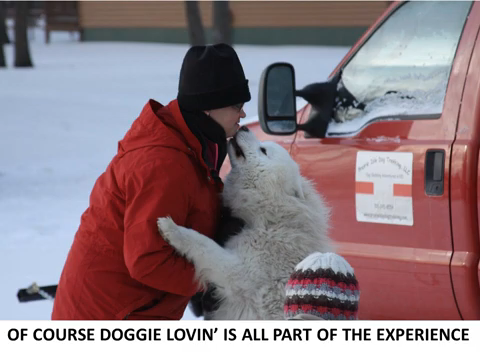
Helen L. Corlew runs a team of Samoyeds, Alaskan malamutes and Alaskan huskies. I am a Tellington TTouch practitioner and use this mode of work with training and living with my dogs.
Helen Corlew founded Prairie Isle Dog Trekking in Petersburg, North Dakota in 2010, and has spent the fifteen years since doing something most people only read about: teaching real dog sledding on real prairie terrain, at the edge of a landscape that doesn’t apologize for being difficult.
She is not a weekend enthusiast. She harnesses working dogs in January cold, trains handlers who have never touched a sled, and has built one of the only hands-on mushing education programs on the Northern Great Plains — from a single address on Highway 2, with no marketing budget and no shortcuts.
Her writing on Prairie Isle Dog Trekking reflects the same philosophy. Whether she is covering trail safety across the Rockies, breed behavior in extreme conditions, or what it actually takes to trek with a dog in the Alps, Helen writes from the position of someone who has done the work before writing the sentence.
She lives and runs dogs in Nelson County, North Dakota.
Kindly follow me on Social Media!
