

The dog sat down in the middle of the trail and wouldn’t get up. Not tired-wouldn’t, not stubborn-wouldn’t. Just done. She was a three-year-old Siberian, healthy, well-conditioned, and the temperature was sixty-two degrees.
Sixty-two. October. The kind of day that feels like nothing to a person walking in a jacket.
I called it right there. Unhooked her, loaded her in the sled bag, finished the run short. My assistant at the time thought I was overreacting. I didn’t argue with him. The dog had told me something and I heard it, and that was the end of the conversation.
That was eleven years ago and I think about it every summer when the articles start appearing about people taking dogs down the Havasupai Trail in July. The Havasupai. In July. Eight miles down into a canyon in Arizona where the air temperature routinely hits a hundred and ten and the red rock holds heat the way cast iron does, radiating it back up from below while the sun works on you from above, and people are doing this with dogs on leashes and calling it an adventure.
Petersburg, North Dakota is not a desert. What I know about extreme heat I know from the other direction, from the way cold shuts a body down so quietly you miss it happening, from watching dogs for the specific behavioral signals that mean something is going wrong before the going wrong becomes visible. But the physiology is not as different as people think. A body under thermal stress is a body under thermal stress. The signals change. The outcome doesn’t.
What I read in those articles, and I’ve read enough of them now to see the pattern, is people describing their dogs as willing. Eager. Keeping up fine until they weren’t. That phrase is doing a lot of work. It’s covering the distance between a dog that can tell you nothing is wrong and a dog that has no language for wrong except collapse.
Dogs do not pace themselves for conditions they don’t understand. They match your energy. They follow your lead. They will walk into a situation that is killing them because you are walking into it and you are the fixed point their whole world organizes around. That’s not loyalty in some elevated sense. That’s just how they’re built. The same quality that makes a working dog worth anything on a cold trail in February is the exact quality that makes a dog dangerous to take down a canyon in July. They will go until they stop.

The Havasupai Trail specifically. Eight miles in, ten miles out, that uneven mileage telling you something right there about the grade. Exposed switchbacks. No shade for long stretches. The water down at the bottom is the carrot, and it’s a real carrot, turquoise and cold and beautiful from every photograph I’ve ever seen, but the dog isn’t going down there for the water. The dog is going down there because you are going down there.
I had a family out two summers ago during the one week in July we get that actually feels like summer up here. Warm enough that I modified the run, shortened the route, watched the dogs the whole time with a different kind of attention than I use in February. The father asked me afterward why I kept stopping. I told him the dogs told me to. He laughed, a little uncertain, like he wasn’t sure if I was being metaphorical.
I wasn’t.
The trail isn’t what makes the Havasupai dangerous for dogs in July. The trail is just the trail. What makes it dangerous is the gap between what a person can tolerate and what a dog will admit to. Those are two very different thresholds and they almost never arrive at the same place at the same time.
People who take their dogs down that canyon in July are not bad people. They are people who haven’t yet watched a dog decide to quit rather than disappoint them. Once you’ve seen that, you make different decisions. You stop asking the dog if it’s okay and start reading whether it is.
The dog always knows. The question is whether you’re paying enough attention to know too.
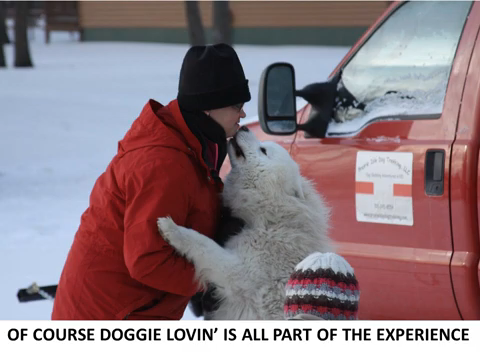
Helen L. Corlew runs a team of Samoyeds, Alaskan malamutes and Alaskan huskies. I am a Tellington TTouch practitioner and use this mode of work with training and living with my dogs.
Helen Corlew founded Prairie Isle Dog Trekking in Petersburg, North Dakota in 2010, and has spent the fifteen years since doing something most people only read about: teaching real dog sledding on real prairie terrain, at the edge of a landscape that doesn’t apologize for being difficult.
She is not a weekend enthusiast. She harnesses working dogs in January cold, trains handlers who have never touched a sled, and has built one of the only hands-on mushing education programs on the Northern Great Plains — from a single address on Highway 2, with no marketing budget and no shortcuts.
Her writing on Prairie Isle Dog Trekking reflects the same philosophy. Whether she is covering trail safety across the Rockies, breed behavior in extreme conditions, or what it actually takes to trek with a dog in the Alps, Helen writes from the position of someone who has done the work before writing the sentence.
She lives and runs dogs in Nelson County, North Dakota.
Kindly follow me on Social Media!
