
What the Dog Knows
Kodiak came off the line wrong that morning, the whole left side of his body angled out like he was already done with the run before it started, and I knew before I’d taken three steps toward him. Something in the hip. Not dramatic. Just off. The kind of thing you only catch if you’ve looked at enough dogs moving correctly that wrong registers in your chest before your brain names it.
I scratched him. Pulled him from the team, put him in the warm kennel, heard him complain about it the whole time I was re-rigging the gangline. He didn’t understand. That’s the part people never want to sit with. A dog that wants to work more than anything, and the person who knows him best is the one who tells him no.
Someone sent me the Scout story last February. Border collie out of California, guided more than three hundred blind hikers up Mount Whitney. The message said: Have you seen this? Incredible, right? And I read the whole piece, and I thought about it for two days before I figured out what was bothering me.
It isn’t that Scout isn’t remarkable. He is. Three hundred ascents, fourteen thousand feet, technical terrain, altitude, weather. That dog has put in real work and the handler has put in more. I’m not dismissing any of it.
What bothered me was the framing. Every paragraph was about the hikers. Their courage. Their accomplishment. The metaphors about darkness and light that every journalist reaches for when a blind person does something physical, like they can’t help themselves. Scout showed up in the piece as a vehicle. A miracle with fur. The thing that made the human story possible.
Nobody asked what the dog was doing.
I had a woman come out here three winters ago, legally blind since her mid-thirties, wanted to run dogs. Her name was Carla and she’d done adaptive sports before and she was not interested in being handled carefully. She told me that the first ten minutes. We talked about the dogs for an hour before we talked about her eyes at all, and what she wanted to know was not how we’d accommodate her but how the dogs communicated, what signals they used, what it felt like when the team was running well versus running anxious.
When we got out on the snow, minus five, the cold burning clean and sharp at the back of the throat, she stood at the sled and I watched her listen. The dogs were in full pre-run chaos, barking, lunging, the gangline snapping taut and releasing, and she just stood there taking it in through everything except her eyes. She picked up the handlebar and said, okay, and we went.
She told me afterward that she’d felt Kopek’s mood change about thirty seconds before the team settled. Through the sled. Through her hands on the bar. I had felt it too, same moment, and I’d been running dogs for years by then.
That’s not magic. That’s information. The dog is always broadcasting. Most people are just too distracted by what they can see to receive it.
What Scout is doing on Mount Whitney, three hundred times over, is not performing a miracle for the humans beside him. He is doing a job that asks everything of him, reading terrain and wind and footing and human gait and altitude and a thousand other inputs simultaneously, making real-time decisions that the story doesn’t have language for because the journalist never thought to ask. The hikers aren’t following a feel-good story. They’re trusting a working mind that happens to have four legs.
Kodiak sat in his kennel that morning and hollered while the other dogs ran. By the time I came back he’d stopped. He was lying down, watching the tree line, doing whatever dogs do when they’re not working. Resting into it. Not suffering over it.
I’ve thought about that a lot. The dogs don’t need the story we build around them. They need the work, and the rest, and a person who can tell the difference between the two.
Scout knows which three hundred hikes he did. He knows every trail, every stumble he caught before it happened, every moment the wind shifted and he adjusted without being asked. He carries all of it. He just doesn’t need anyone to write it down.
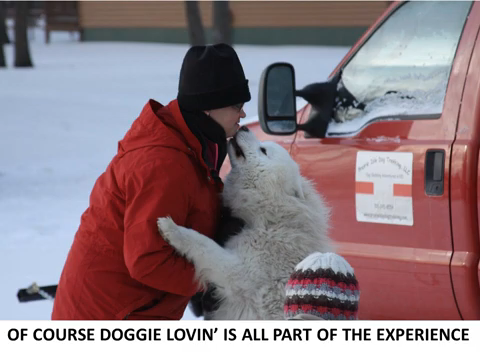
Helen L. Corlew runs a team of Samoyeds, Alaskan malamutes and Alaskan huskies. I am a Tellington TTouch practitioner and use this mode of work with training and living with my dogs.
Helen Corlew founded Prairie Isle Dog Trekking in Petersburg, North Dakota in 2010, and has spent the fifteen years since doing something most people only read about: teaching real dog sledding on real prairie terrain, at the edge of a landscape that doesn’t apologize for being difficult.
She is not a weekend enthusiast. She harnesses working dogs in January cold, trains handlers who have never touched a sled, and has built one of the only hands-on mushing education programs on the Northern Great Plains — from a single address on Highway 2, with no marketing budget and no shortcuts.
Her writing on Prairie Isle Dog Trekking reflects the same philosophy. Whether she is covering trail safety across the Rockies, breed behavior in extreme conditions, or what it actually takes to trek with a dog in the Alps, Helen writes from the position of someone who has done the work before writing the sentence.
She lives and runs dogs in Nelson County, North Dakota.
Kindly follow me on Social Media!
