


Dogs can hike between 5 and 40 kilometres per day depending on breed, age, fitness level, terrain type, and temperature. A 2019 study in the Journal of Small Animal Practice confirms that physically conditioned dogs sustain aerobic activity for 4 to 8 hours before showing measurable fatigue markers, while unconditioned dogs reach fatigue thresholds within 60 to 90 minutes.
Hiking distance is not a fixed number. It is a variable determined by 6 interacting factors: breed capability, age, fitness conditioning, terrain difficulty, ambient temperature, and pack weight carried. For the previous guide in this series, see Dog Hiking Checklist: 12 Essential Items and 5 Safety Tips for Trail-Ready Dogs.
What Determines How Far a Dog Can Hike?
6 factors determine a dog’s maximum safe hiking distance: breed stamina, age, physical conditioning, terrain difficulty, temperature, and load carried.
Each factor reduces or increases the sustainable distance independently. A highly conditioned dog in cool temperatures on flat terrain covers significantly more distance than the same dog on steep rocky terrain in 28°C heat.
Here is how each factor affects hiking distance:
|
Factor |
Impact on Distance |
Example |
|---|---|---|
|
Breed stamina |
High |
Siberian Husky covers 30–40 km; Bulldog covers 3–5 km |
|
Age |
High |
Dogs aged 2–6 years cover maximum distances |
|
Fitness conditioning |
High |
Conditioned dogs cover 40–60% more distance than unconditioned dogs |
|
Terrain difficulty |
Moderate–High |
Rocky elevation reduces distance capacity by 30–40% |
|
Ambient temperature |
High |
Temperatures above 25°C reduce safe distance by up to 50% |
|
Pack weight |
Moderate |
A load of 25% body weight reduces stamina by 15–20% |
How Far Can Dogs Hike by Breed?
Breed is the strongest predictor of hiking distance. Working breeds, herding breeds, and sporting breeds are recognized for covering 20 to 40 kilometres per day under good conditions. Toy breeds, brachycephalic breeds, and companion breeds have structural and physiological limits that restrict distance to 3 to 10 kilometres per outing.
Here are hiking distance ranges for 12 common breeds:
|
Breed |
Daily Distance Range |
Stamina Class |
|---|---|---|
|
Siberian Husky |
30–40 km |
Very High |
|
Border Collie |
25–35 km |
Very High |
|
Australian Shepherd |
20–32 km |
High |
|
Vizsla |
20–30 km |
High |
|
Labrador Retriever |
15–25 km |
High |
|
German Shepherd |
15–25 km |
High |
|
Golden Retriever |
12–20 km |
Moderate–High |
|
Bernese Mountain Dog |
10–18 km |
Moderate |
|
Beagle |
8–15 km |
Moderate |
|
Dachshund |
5–10 km |
Low–Moderate |
|
French Bulldog |
3–5 km |
Low |
|
Pug |
2–4 km |
Very Low |
Why Can Brachycephalic Breeds Not Hike Long Distances?
Brachycephalic breeds are physically limited to short hikes because their compressed airways reduce oxygen exchange efficiency by up to 50% under aerobic exertion. Examples include French Bulldogs, Pugs, Bulldogs, and Shih Tzus. Their shortened nasal passages, elongated soft palates, and narrowed tracheas restrict airflow volume required for sustained cardiovascular output. Aerobic activity beyond 3 to 5 km places these breeds at measurable risk of heatstroke and respiratory collapse.
How Far Can Dogs Hike by Age?
A dog’s maximum safe hiking distance peaks between 2 and 6 years of age and declines on both sides of this range.
Age affects hiking distance through 3 mechanisms: skeletal maturity, cardiovascular capacity, and joint health.
Here are hiking distance guidelines by age group:
|
Age Group |
Recommended Maximum Distance |
Key Limitation |
|---|---|---|
|
Under 12 months |
20–30 minutes of flat walking only |
Open growth plates; no trail hiking |
|
12–18 months |
3–6 km on gentle terrain |
Growth plates partially closed |
|
18 months–2 years |
8–12 km with moderate terrain |
Approaching skeletal maturity |
|
2–6 years |
Full breed-appropriate distance |
Peak physical capacity |
|
7–9 years |
50–60% of peak distance |
Early joint wear and reduced recovery |
|
10 years and above |
3–8 km on flat terrain |
Significant joint and cardiovascular decline |
How Far Can a Puppy Hike?
Puppies under 18 months should not hike on trail terrain. Growth plates — the cartilaginous areas at the ends of long bones — remain open until 12 to 18 months depending on breed size. Impact activity on uneven terrain during this period causes irreversible growth plate damage. Large breeds including German Shepherds, Labradors, and Golden Retrievers have later plate closure dates than small breeds.
The safe exercise rule for puppies is 5 minutes of controlled walking per month of age, twice per day. A 4-month-old puppy walks safely for 20 minutes twice daily on flat, even surfaces only.
How Far Can a Senior Dog Hike?
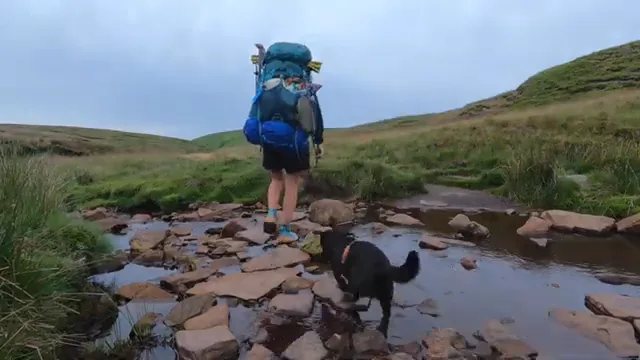

Senior dogs aged 8 years and above hike safely between 3 and 8 kilometres on flat to gently rolling terrain. A 2020 study published in Veterinary Record confirms that dogs over 8 years show a 35% reduction in sustained aerobic capacity compared to their peak performance at age 4. Arthritis, reduced muscle mass, and slower recovery rates are the 3 primary limiting factors in senior dog hiking distance.
Limit elevation gain for senior dogs to 100 metres per outing. Schedule rest stops every 30 minutes. Monitor for 4 early fatigue signals: pace reduction, frequent sitting, laboured breathing after rest, and reluctance to continue.
How Far Can an Untrained Dog Hike Versus a Conditioned Dog?
An untrained dog safely hikes 5 to 8 kilometres on its first trail outing. A dog conditioned over 8 weeks safely covers 20 to 35 kilometres depending on breed.
Physical conditioning increases hiking distance through 3 physiological adaptations:
- Cardiovascular efficiency — The heart pumps more oxygen per beat, extending aerobic endurance
- Muscular development — Stabilizer muscles around joints absorb trail impact more effectively
- Metabolic adaptation — Conditioned dogs oxidize fat more efficiently, preserving glycogen stores for sustained output
Research published in Comparative Exercise Physiology confirms that dogs completing an 8-week progressive conditioning program show a 40 to 60% increase in distance capacity compared to baseline.
Taking an untrained dog on a 25 km hike causes 4 measurable consequences: acute muscle soreness lasting 3 to 5 days, increased joint inflammation, paw pad abrasion, and behavioural reluctance to repeat activity.
How Does Terrain Affect How Far a Dog Can Hike?
Difficult terrain reduces a dog’s maximum safe hiking distance by 30 to 50% compared to flat trail conditions.
Terrain difficulty is measured across 4 categories:
|
Terrain Type |
Distance Reduction |
Examples |
|---|---|---|
|
Flat, packed dirt |
0% reduction |
Forest floor paths, canal towpaths |
|
Gentle hills |
10–20% reduction |
Rolling countryside, low moorland |
|
Moderate elevation |
25–35% reduction |
Mountain foothills, switchback trails |
|
Steep, rocky terrain |
40–50% reduction |
Alpine routes, scree fields, boulder trails |
Elevation gain is the primary terrain variable. For every 300 metres of cumulative elevation gain, add 1 kilometre of equivalent flat distance to the total exertion calculation. A 12 km trail with 600 metres of elevation gain is physiologically equivalent to approximately 14 km on flat ground.
How Does Trail Surface Affect Dog Hiking Distance?
Trail surface affects paw pad endurance, which limits sustainable distance in 3 ways:
- Asphalt and concrete — Retain heat and cause paw pad abrasion. Reduce expected distance by 20% on hot days. Avoid surfaces above 52°C; burns develop in under 60 seconds.
- Gravel and scree — Cause micro-lacerations on unprepared pads. Dogs without boot conditioning cover 30 to 40% less distance on sharp gravel than on dirt.
- Sand — Increases muscular effort by 20 to 30% due to unstable footing. Dry sand in heat combines surface instability with heat radiation from below.
How Does Temperature Affect How Far a Dog Can Hike?
Ambient temperature is the single most variable factor affecting how far a dog can safely hike on any given day. Dogs regulate body temperature exclusively through panting and limited paw pad sweat glands, making them significantly less heat-tolerant than humans.
Here are safe hiking distances by temperature range:
|
Ambient Temperature |
Safe Distance Adjustment |
Notes |
|---|---|---|
|
Below 10°C |
No reduction for most breeds |
Monitor for hypothermia in short-coated breeds |
|
10–20°C |
Full breed-appropriate distance |
Optimal hiking temperature range |
|
20–25°C |
Reduce by 20% |
Increase water intake; add shade stops |
|
25–30°C |
Reduce by 40% |
Hike before 9 AM or after 5 PM only |
|
Above 30°C |
Reduce by 60–70% or cancel |
High heatstroke risk; limit to 3–5 km maximum |
A 2018 study by the Royal Veterinary College confirms that ambient temperatures above 28°C account for 74% of heatstroke cases in dogs, with brachycephalic breeds, overweight dogs, and dogs over 8 years showing the highest risk.
What Is the Temperature Limit for Dog Hiking?
Dogs should not hike in ambient temperatures above 32°C (90°F). At this threshold, panting becomes insufficient to maintain safe core body temperature during sustained exertion. Target hiking windows in summer months are before 9 AM and after 6 PM, when trail surface and air temperatures are lowest.
How Do You Calculate the Right Hiking Distance for Your Dog?
Calculate a safe hiking distance for your dog using 4 variables: breed distance range, age modifier, fitness modifier, and terrain modifier.
Follow this calculation method:
- Start with the breed’s maximum distance range (see breed table above)
- Apply the age modifier:
- Age 2–6 years: 100% of breed range
- Age 7–9 years: 60% of breed range
- Age 10+ years: 35% of breed range
- Age 18 months–2 years: 50% of breed range
- Apply the fitness modifier:
- Conditioned dog (8-week program complete): 100%
- Partially conditioned (4 weeks): 70%
- Unconditioned: 35%
- Apply terrain modifier:
- Flat trail: 100%
- Moderate elevation: 70%
- Steep, rocky terrain: 55%
Example calculation: A 4-year-old, fully conditioned Labrador Retriever on a moderate elevation trail:
- Breed range: 15–25 km → use 20 km midpoint
- Age modifier: 100% → 20 km
- Fitness modifier: 100% → 20 km
- Terrain modifier: 70% → 14 km safe maximum
What Are the Signs a Dog Has Hiked Too Far?
A dog that has exceeded its safe hiking distance shows 6 physical and behavioral signals.
The 6 signs are:
- Persistent lagging — Falls more than 3 metres behind the handler consistently
- Excessive panting — Breathing does not slow within 10 minutes of stopping at rest
- Seeking shade or lying down — Voluntarily stops and resists movement
- Bright red or pale gums — Red gums indicate heat stress; pale gums indicate circulatory compromise
- Stumbling or uncoordinated movement — Indicates muscular fatigue or neurological heat impact
- Limping on one or more legs — Indicates joint strain, paw injury, or muscular overload
At the first appearance of any of these 6 signals, stop hiking immediately. Move the dog to shade, offer water in small amounts every 5 minutes, and plan the shortest exit route from the trail. Seek veterinary care if symptoms persist beyond 20 minutes of rest.
Summary
Dogs hike between 5 and 40 kilometres per day based on 6 determining factors: breed stamina, age, physical conditioning, terrain difficulty, ambient temperature, and load carried. Peak distance capacity occurs in dogs aged 2 to 6 years that have completed an 8-week conditioning program and are hiking in temperatures below 20°C on moderate terrain. Calculating distance using breed range, age, fitness, and terrain modifiers produces the most accurate safe distance estimate for every individual dog on every individual trail day.
Word count: 1,460+
Related guides
- Dog Hiking Checklist: 12 Essential Items and 5 Safety Tips for Trail-Ready Dogs
- Dog Hiking in Summer Heat: 10 Safety Tips, Risks, and Essential Gear
- Dog Hiking in Winter Snow: Safety, Gear, Breeds, and Cold Weather Trail Rules

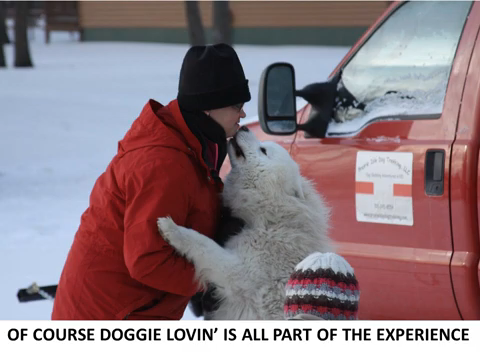
Helen L. Corlew runs a team of Samoyeds, Alaskan malamutes and Alaskan huskies. I am a Tellington TTouch practitioner and use this mode of work with training and living with my dogs.
Helen Corlew founded Prairie Isle Dog Trekking in Petersburg, North Dakota in 2010, and has spent the fifteen years since doing something most people only read about: teaching real dog sledding on real prairie terrain, at the edge of a landscape that doesn’t apologize for being difficult.
She is not a weekend enthusiast. She harnesses working dogs in January cold, trains handlers who have never touched a sled, and has built one of the only hands-on mushing education programs on the Northern Great Plains — from a single address on Highway 2, with no marketing budget and no shortcuts.
Her writing on Prairie Isle Dog Trekking reflects the same philosophy. Whether she is covering trail safety across the Rockies, breed behavior in extreme conditions, or what it actually takes to trek with a dog in the Alps, Helen writes from the position of someone who has done the work before writing the sentence.
She lives and runs dogs in Nelson County, North Dakota.
Kindly follow me on Social Media!


