

The father was standing at the back of the group with his hands jammed in his pockets, not the polite kind of hanging back but the kind where you can tell the whole trip was someone else’s idea. His daughter had picked the experience as a birthday thing, twelve years old, and she was already at the front asking questions about harness fit while he stood twenty feet away looking at his phone.
I handed him a lead line attached to Boone, one of my older males, calm enough for anyone. I didn’t ask. I just handed it to him and walked away.
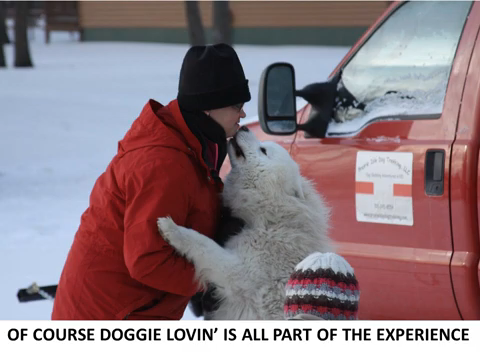
Twenty minutes later he was crouched in the snow next to Boone with his phone in his pocket and his gloves off, running his hands along the dog’s back the way you do when you stop thinking about what you’re doing, and he was talking to him. Not to his daughter. To the dog. Just saying things quietly while Boone stood there accepting it like it was his job, which on some level it was.
I’ve watched that happen more times than I can count. The reluctant one always goes the hardest by the end.
There are articles now about the health benefits of hiking with dogs. Cardiovascular improvements. Cortisol reduction. Increased step counts. Vitamin D. The research is real and some of it is interesting and none of it touches the actual thing, which is that a dog on a trail in cold weather requires your full attention and your full attention is the one thing most people haven’t given anything in years.
On flat prairie in January, before the team starts, there is a silence that doesn’t exist anywhere else. No trees to hold sound, no topography to bounce it. The cold sits on the land and everything is still and the only things moving are the dogs, who are never still, and you, and whatever is happening between you. You cannot be in that and also be somewhere else in your head. The cold burns too specific for that, the sharp minus-ten kind that announces itself differently in your sinuses than the wet heavy cold of minus-two, and the dogs are pulling and the ground is uneven under the snow and your body is doing fifteen things at once and the mental noise that followed you out from the parking lot just doesn’t survive the first quarter mile.
That’s the health benefit. Not the steps.
The research will catch up to it eventually. There’s already work on what they’re calling embodied cognition, the idea that the body’s engagement with a physical environment changes how the brain processes stress, and that natural settings with an animal present produce something measurably different than either one alone. I read that and thought about every person I’ve seen come off a run looking like they’d left something behind that they’d been carrying for a long time.
What the articles miss is that the dog is not incidental to any of this. The dog is the mechanism.
Boone knew that father needed to stop performing and start being somewhere. Dogs read that. They read the held shoulders and the deliberate blankness and they just wait it out, patient in a way that isn’t passive, more like the patience of something that knows something you don’t yet. Boone leaned into that man’s hands and the man’s hands moved and something in his chest came down about three inches.
My hands stop working around minus twenty. Not painfully, just quietly, and then I reach for a clip and they don’t close right and I have to look at them to understand what’s happening. I’ve learned to check before I need them. That kind of attention, to your own body, to what the cold is doing, to what the dog is doing three feet ahead of you in uncertain footing, it’s not meditation. It’s not exercise in the sense anyone means when they say exercise. It’s closer to being awake in a way that daily life does not require.
Every person who has ever come out here and said some version of I needed this today, they’re not talking about their step count.
The dog knows where you are. You have to go there to work with them. That’s the whole thing, really, and no study has found a way to measure it that does it justice.
Helen L. Corlew runs a team of Samoyeds, Alaskan malamutes and Alaskan huskies. I am a Tellington TTouch practitioner and use this mode of work with training and living with my dogs.
Helen Corlew founded Prairie Isle Dog Trekking in Petersburg, North Dakota in 2010, and has spent the fifteen years since doing something most people only read about: teaching real dog sledding on real prairie terrain, at the edge of a landscape that doesn’t apologize for being difficult.
She is not a weekend enthusiast. She harnesses working dogs in January cold, trains handlers who have never touched a sled, and has built one of the only hands-on mushing education programs on the Northern Great Plains — from a single address on Highway 2, with no marketing budget and no shortcuts.
Her writing on Prairie Isle Dog Trekking reflects the same philosophy. Whether she is covering trail safety across the Rockies, breed behavior in extreme conditions, or what it actually takes to trek with a dog in the Alps, Helen writes from the position of someone who has done the work before writing the sentence.
She lives and runs dogs in Nelson County, North Dakota.
Kindly follow me on Social Media!
