

Bikejoring is a dog sport where 1 or 2 harnessed dogs are attached to a bicycle via a bungee tow line and pull the rider along a trail. It originates from sled dog mushing and is practiced across North America, Europe, and Australia. Bikejoring combines cardiovascular training for both dog and rider across 5 core disciplines: equipment setup, obedience commands, conditioning, trail selection, and safety management.
What Is Bikejoring with Dogs?
Bikejoring is a non-motorised dog sport where a dog is attached to a bicycle via a bungee line and harness and pulls the cyclist forward while the rider pedals to assist. For the previous guide in this series, see Canicross Beginner Guide: 8 Training Steps, Essential Gear, and Safety Rules.
The sport derives from skijoring and dryland mushing. It is governed internationally by the International Federation of Sleddog Sports (IFSS). Bikejoring is practiced on dirt trails, gravel paths, and forest tracks. Speeds typically range from 15 to 30 km/h depending on the dog breed, terrain, and distance.
According to the IFSS, bikejoring is one of the fastest-growing dryland dog sports globally, with registered competitions held across 30 countries.
Which Dog Breeds Are Best for Bikejoring?
8 dog breeds are recognised for bikejoring performance: Siberian Husky, Alaskan Malamute, German Shorthaired Pointer, Vizsla, Weimaraner, Border Collie, Labrador Retriever, and Belgian Malinois.
Suitable breeds share 3 key traits: high endurance, a natural forward drive, and joint structure capable of sustained pulling.
Bikejoring Breed Comparison
| Breed | Build | Ideal Distance | Optimal Temperature |
|---|---|---|---|
| Siberian Husky | Medium, lean | 10–20 km | Below 10°C |
| German Shorthaired Pointer | Medium, athletic | 8–15 km | Below 15°C |
| Vizsla | Medium, lean | 8–12 km | Below 18°C |
| Alaskan Malamute | Large, heavy | 5–10 km | Below 5°C |
| Belgian Malinois | Medium, muscular | 6–12 km | Below 15°C |
Note that brachycephalic breeds — examples include Bulldogs, Pugs, and Boxers — are not suitable for bikejoring. Their restricted airways prevent adequate oxygen intake during sustained pulling effort.
Dogs must be at least 18 months old before beginning bikejoring training. Growth plates close between 12 and 18 months, and pulling stress before closure causes permanent joint damage.
What Equipment Is Required for Bikejoring?
5 pieces of equipment are required for bikejoring: a dog harness, bungee tow line, bikejoring attachment, a suitable bicycle, and a rider helmet.
Bikejoring Equipment List
| Equipment | Specification | Purpose |
|---|---|---|
| X-back or H-harness | Padded, weight-distributing fit | Distributes pulling load across chest and back |
| Bungee tow line | 2.0–2.5 metres with shock cord | Absorbs sudden lunges and direction changes |
| Bikejoring attachment | Handlebar or front fork mount | Keeps line away from front wheel |
| Mountain or hybrid bike | Front suspension recommended | Absorbs trail vibration and roots |
| Rider helmet | CE EN1078 certified | Protects against head injury on falls |
Never attach a tow line to a dog’s collar. Collar attachment concentrates force on the neck and causes tracheal injury during hard pulls. Use only a purpose-built pulling harness.
A bikejoring attachment — also called a springer or outrigger — mounts to the front fork or handlebar stem. It holds the tow line at a fixed lateral position and prevents the line from entering the front wheel during turns.
How Do You Train a Dog for Bikejoring?
Train a dog for bikejoring in 4 sequential phases: leash running, command conditioning, line introduction, and on-bike sessions.
4-Phase Bikejoring Training Plan
- Leash Running — Run with the dog on a 2-metre leash for 2–4 weeks. Build baseline fitness and directional responsiveness.
- Command Conditioning — Teach 6 core commands before introducing the bike.
- Line Introduction — Attach the bungee line to the harness. Walk, then jog, with the line attached but without the bike.
- On-Bike Sessions — Begin with 1–2 km at low speed on flat terrain. Increase distance by no more than 10% per week.
6 Core Bikejoring Commands
- Hike — move forward
- Gee — turn right
- Haw — turn left
- Whoa — stop immediately
- Easy — reduce speed
- On by — pass a distraction without breaking pace
Command reliability at 95% accuracy is the minimum standard before beginning on-bike sessions. A dog that breaks direction commands at speed creates a high-risk crash scenario.
What Is the Correct Bikejoring Setup?
The correct bikejoring setup positions the dog 2.0–2.5 metres ahead of the front wheel, with the tow line running from the harness attachment point to the bike’s front fork mount.
The tow line must remain taut during movement but contain 30–40 cm of bungee section to absorb shock. A slack line risks wheel entanglement. A rigid line transfers every sudden movement directly to the rider’s handlebars.
Set saddle height so the rider’s knee maintains a 5–10 degree bend at full pedal extension. This allows active pedalling to assist the dog on inclines and reduces fatigue over distances above 10 km.
How Far Can a Dog Run While Bikejoring?
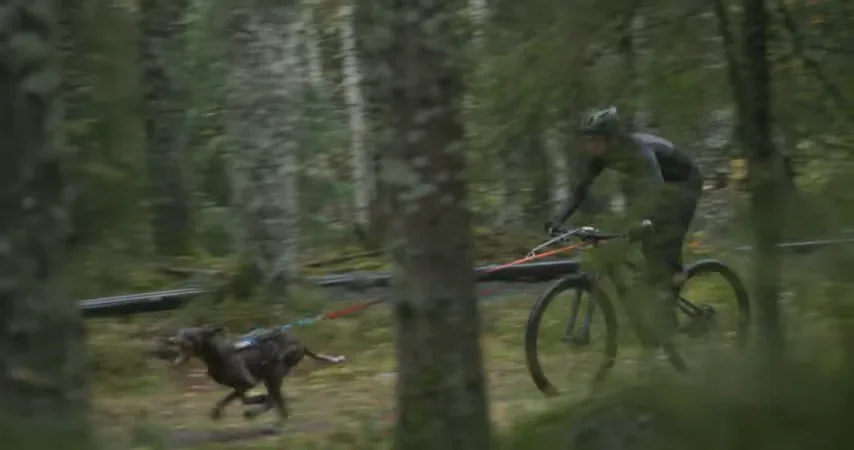
A conditioned bikejoring dog runs 5 to 20 km per session depending on breed, fitness level, age, and ambient temperature.
Distance Guidelines by Fitness Level
| Level | Session Distance | Weekly Volume | Rest Days |
|---|---|---|---|
| Beginner (0–4 weeks) | 1–3 km | 6–9 km | 4 days |
| Intermediate (1–3 months) | 4–8 km | 20–30 km | 3 days |
| Advanced (3+ months) | 10–20 km | 40–60 km | 2 days |
Increase weekly volume by no more than 10% between training phases. The Journal of Veterinary Behavior identifies overtraining as the primary cause of repetitive stress injuries in canine athletes. Paw pad abrasion, shoulder strain, and carpal joint inflammation are the 3 most reported bikejoring injuries in dogs.
What Are the Safety Rules for Bikejoring?
9 safety rules govern bikejoring with dogs.
- Never bikejor on asphalt when ground temperature exceeds 25°C — paw burns develop in under 60 seconds on hot surfaces
- Always use a bungee tow line — never a fixed rigid line
- Never attach the line to the dog’s collar
- Stop the session if the dog shows panting above normal recovery rate, stumbling, or refusal to pull
- Carry 500 ml of fresh water per dog per 5 km of distance
- Avoid roads with vehicle traffic — use dedicated trails or closed paths only
- Fit the rider with a CE-certified helmet before every session
- Do not bikejor with dogs under 18 months of age
- Check paw pads before and after every session for cuts, splits, and abrasion
The American Kennel Club recommends a full veterinary health check before beginning any pulling sport. This includes hip, elbow, and cardiac screening for breeds predisposed to joint or heart conditions.
What Are the Health Benefits of Bikejoring for Dogs?
Bikejoring delivers 5 measurable health benefits for dogs: cardiovascular conditioning, weight management, joint mobility, mental stimulation, and reduced anxiety.
A study published in the Journal of Small Animal Practice found that dogs engaged in regular structured exercise showed a 30% reduction in anxiety-related behaviours compared to dogs receiving only leash walks. Bikejoring satisfies a working dog’s instinct to pull, run, and operate as part of a team — stimuli that standard exercise does not replicate.
Running at a self-selected pace in a forward-pulling posture develops the dog’s core musculature, hindquarter drive, and cardiovascular endurance simultaneously. Sessions of 5–10 km at moderate intensity provide equivalent conditioning to 45–60 minutes of controlled interval training.
Where Can You Go Bikejoring with Your Dog?
3 trail types are suitable for bikejoring: forested singletrack trails, gravel fire roads, and closed rail-trail corridors.
Suitable surfaces share 4 characteristics: firm but not concrete-hard ground, consistent width of at least 1.5 metres, low pedestrian traffic, and clear sightlines ahead.
Avoid trails with sharp switchbacks, exposed tree roots on high-speed descents, or sections shared with horses. Bikejoring speeds of 20–30 km/h create high-risk collision scenarios on narrow, shared trails.
In the U.S., rail trails managed by the Rails-to-Trails Conservancy network cover over 25,000 miles of traffic-free corridor. A growing number of these explicitly permit bikejoring. Always verify the specific trail’s dog and cycling policy before use.
Related guides
- Camping with Dogs: 8 Essential Gear Items, Safety Rules, and Campsite Guide
- Canicross Beginner Guide: 8 Training Steps, Essential Gear, and Safety Rules
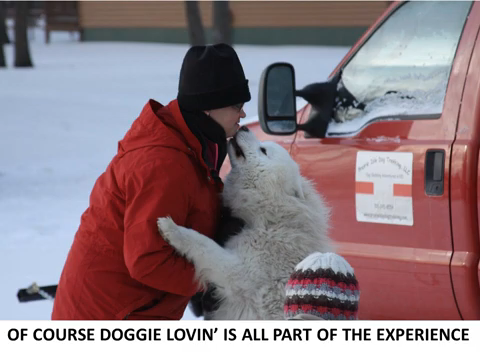
Helen L. Corlew runs a team of Samoyeds, Alaskan malamutes and Alaskan huskies. I am a Tellington TTouch practitioner and use this mode of work with training and living with my dogs.
Helen Corlew founded Prairie Isle Dog Trekking in Petersburg, North Dakota in 2010, and has spent the fifteen years since doing something most people only read about: teaching real dog sledding on real prairie terrain, at the edge of a landscape that doesn’t apologize for being difficult.
She is not a weekend enthusiast. She harnesses working dogs in January cold, trains handlers who have never touched a sled, and has built one of the only hands-on mushing education programs on the Northern Great Plains — from a single address on Highway 2, with no marketing budget and no shortcuts.
Her writing on Prairie Isle Dog Trekking reflects the same philosophy. Whether she is covering trail safety across the Rockies, breed behavior in extreme conditions, or what it actually takes to trek with a dog in the Alps, Helen writes from the position of someone who has done the work before writing the sentence.
She lives and runs dogs in Nelson County, North Dakota.
Kindly follow me on Social Media!
